Non-Scale Victories: How to Track Progress When the Scale Lies
Founder, MyMacroFit
The scale is a tool, not a verdict. It measures total body mass, which includes muscle, fat, water, food in transit, glycogen, and bones. On any given day, scale weight can fluctuate 1-3kg without any change in body fat.
Most people know this intellectually, but emotionally, a flat week on the scale feels like failure. This guide provides the alternative measurements that actually tell you what's happening with your body composition.
Why the Scale Misleads
Scenario: You're in a 500 kcal daily deficit. You should be losing ~0.5kg/week of fat. Week 3 weigh-in shows no change, or even an increase.
What might actually be happening:
- You started resistance training → muscle gains partially offset fat loss on the scale
- Your menstrual cycle is in the luteal phase → 1-2kg fluid retention
- You ate a higher-sodium meal yesterday → water retention
- You ate more carbohydrates than usual → glycogen refilling adds water
- You trained harder this week → muscle inflammation holds water temporarily
All of these can make scale weight stable or higher while you're actively losing fat. The scale cannot distinguish between them.
The Complete Non-Scale Progress Toolkit
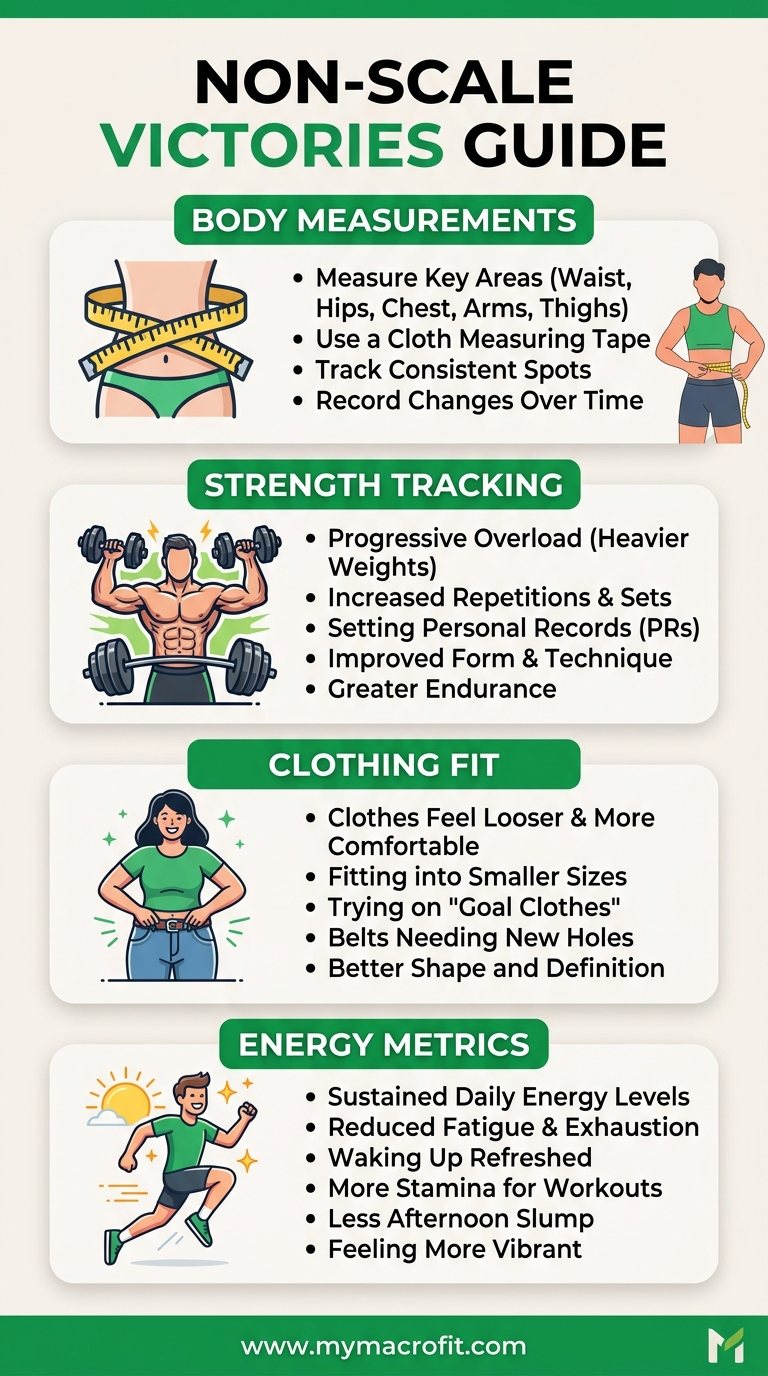
1. Body Measurements (Most Reliable)
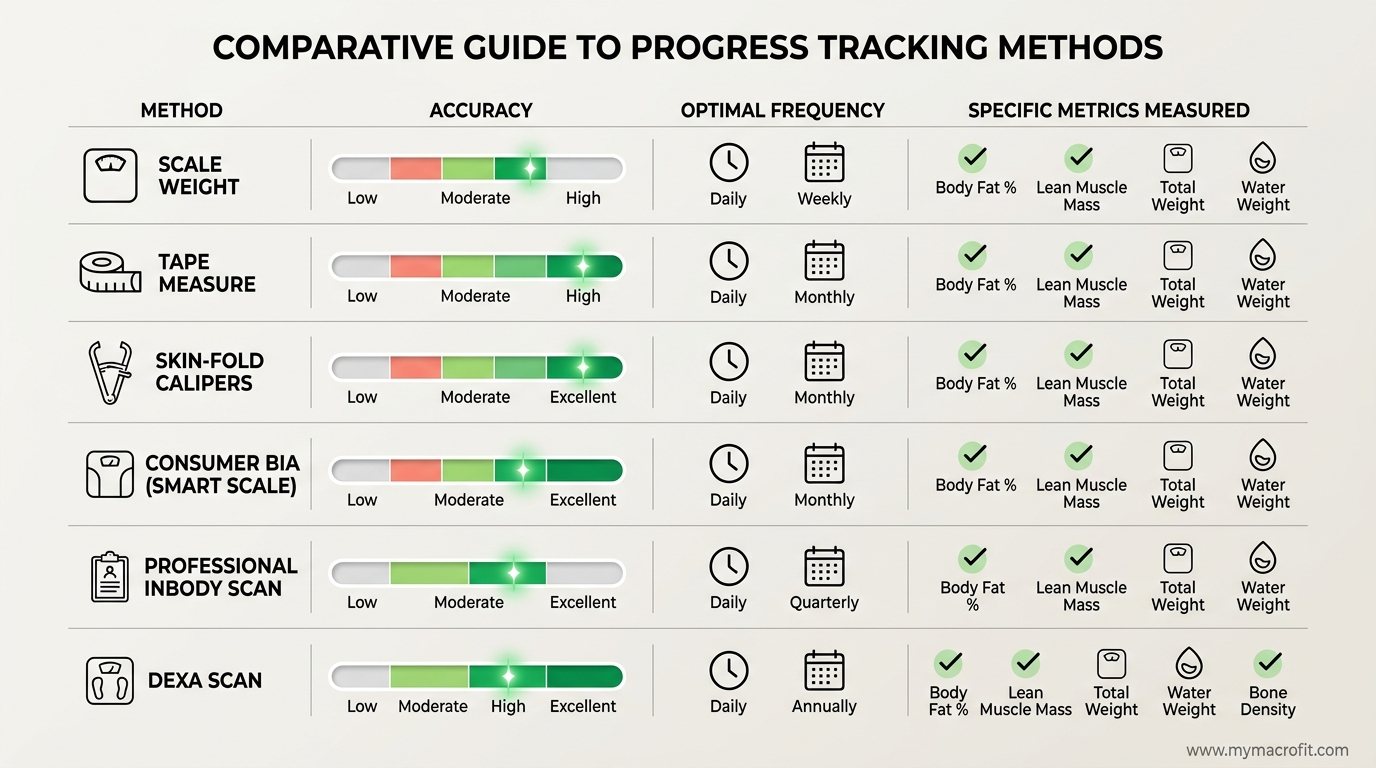
Measure with a flexible tape measure in the morning, before eating, under the same conditions weekly.
Where to measure:
- Waist: at the narrowest point (usually 1-2cm above the navel)
- Hips: at the widest point around the buttocks
- Thighs: mid-thigh circumference (dominant leg)
- Upper arm: mid-bicep circumference
Interpretation: Even a 0.5-1cm reduction in waist circumference represents meaningful fat loss. Waist measurement is particularly important because visceral fat (the metabolically harmful abdominal fat) reduces fastest there.
Expectation: 1-2cm waist reduction per 4 weeks is excellent progress.
2. Progress Photos (Visual Evidence)
Take photos every 4 weeks:
- Same time of day (morning, after bathroom)
- Same lighting (natural if possible)
- Same location and angle
- Front, side, and back views
Key: Compare month-to-month, not week-to-week. Changes that feel invisible in the mirror are often dramatic in month 1 vs. month 3 photo comparisons.
3. Strength Numbers
Training performance is the most objective evidence that your training is working and muscle is being preserved.
Track:
- Squat weight × reps
- Bench press or push-up progression
- Deadlift weight × reps
- Row weight × reps
If you're maintaining or improving these numbers while in a calorie deficit, you're preserving muscle. Strength gains in a deficit indicate you're building muscle simultaneously with fat loss (body recomposition, most achievable for beginners).
4. Clothing Fit
The most emotionally resonant non-scale measure for most people. Use a specific item of clothing as your reference, jeans, a dress, a shirt.
Track: Can I do this up? Is it loose/tight? Where does it fit differently?
Clothes fitting more loosely around the waist and hips while potentially becoming tighter around the shoulders and arms (if building muscle) tells you exactly what body recomposition looks like in practice.
5. Body Fat Percentage
Use our Body Fat Calculator or a DEXA scan to track body fat percentage rather than total weight. This directly measures what you care about, the proportion of your bodyweight that is fat.
A person who goes from 35% body fat to 30% body fat at the same scale weight has lost approximately 3.5kg of fat and replaced it with lean tissue, a meaningful transformation that the scale misses entirely.
6. Energy and Performance Metrics
Resting heart rate: Declining resting heart rate (over months of consistent exercise) is a direct indicator of cardiovascular fitness improvement.
How you feel: Energy levels at 2pm, sleep quality, mood stability, exercise recovery speed, these correlate with improving metabolic health and are genuine progress markers.
Workout capacity: Can you do more? Lift heavier? Recover faster? This is progress.
The Weekly vs. Monthly View
Weekly: Track weight daily, calculate weekly average. Only compare weekly averages.
Monthly: Review progress photos, measurements, and strength numbers. This is where the real narrative of your progress lives.
Most people focus on weekly scale changes when monthly comparisons are the signal that matters. A month where the scale barely moved but waist measurement dropped 2cm and you're lifting 10kg more is a successful month by any meaningful measure.
When to Be Concerned About the Scale (vs. Normal Fluctuation)
Normal: Weekly average weight varies 0.5-1.5kg week to week while showing a downward trend over months.
Worth investigating: Scale has been stable for 4+ weeks AND waist measurements are not decreasing AND strength is not improving. This suggests you may not be in a genuine deficit, use tracking to identify where surplus calories are coming from.
The Bottom Line
Weigh yourself regularly, but treat weekly numbers as one data point among many. The combination of waist measurements, progress photos, strength tracking, and energy levels gives you a far more accurate picture of what's actually happening with your body composition.
The scale will catch up. The real transformation shows up everywhere else first.
Save & share on Pinterest
Click any card to pin it — or share with someone who needs it.
Non-Scale Victories: How to Track Progress When the Scale Lies
Why the scale is a poor indicator of fat loss success, and the non-scale measurements that actually …
Why the scale is a poor indicator of fat loss success, and the non-scale measure…
Read the full guide: Non-Scale Victories: How to Track Progress When the Scale Lies
Try the free Body Fat Calculator
Non-Scale Victories: How to Track Progress When the Scale Lies — use our free calculators for instan…
Pinterest opens in a new tab. You can edit the description before saving.
Ready to get your numbers?
Free calculator, instant results, no signup required.
Frequently Asked Questions
Why is the scale not moving even though I'm doing everything right?+
How do I measure body fat percentage at home?+
What non-scale changes should I notice first?+
How often should I take progress photos and measurements?+
Can I be losing fat but gaining weight at the same time?+
Should I throw out my scale entirely?+
About the Author
I'm the founder of MyMacroFit. I'm not a coach or a dietitian. I'm someone who wanted to lose weight, worked it out the hard way, and built the tools I wish I'd had.
View full profile →