What Is a Calorie? (The Beginner's Complete Answer)

BSc Kinesiology · CPT
If you've ever tried to lose weight or improve your health, you've encountered calories. They're mentioned everywhere, on food labels, in diet advice, in fitness apps. But what actually is a calorie, and how does understanding them help you manage your weight?
The Technical Definition
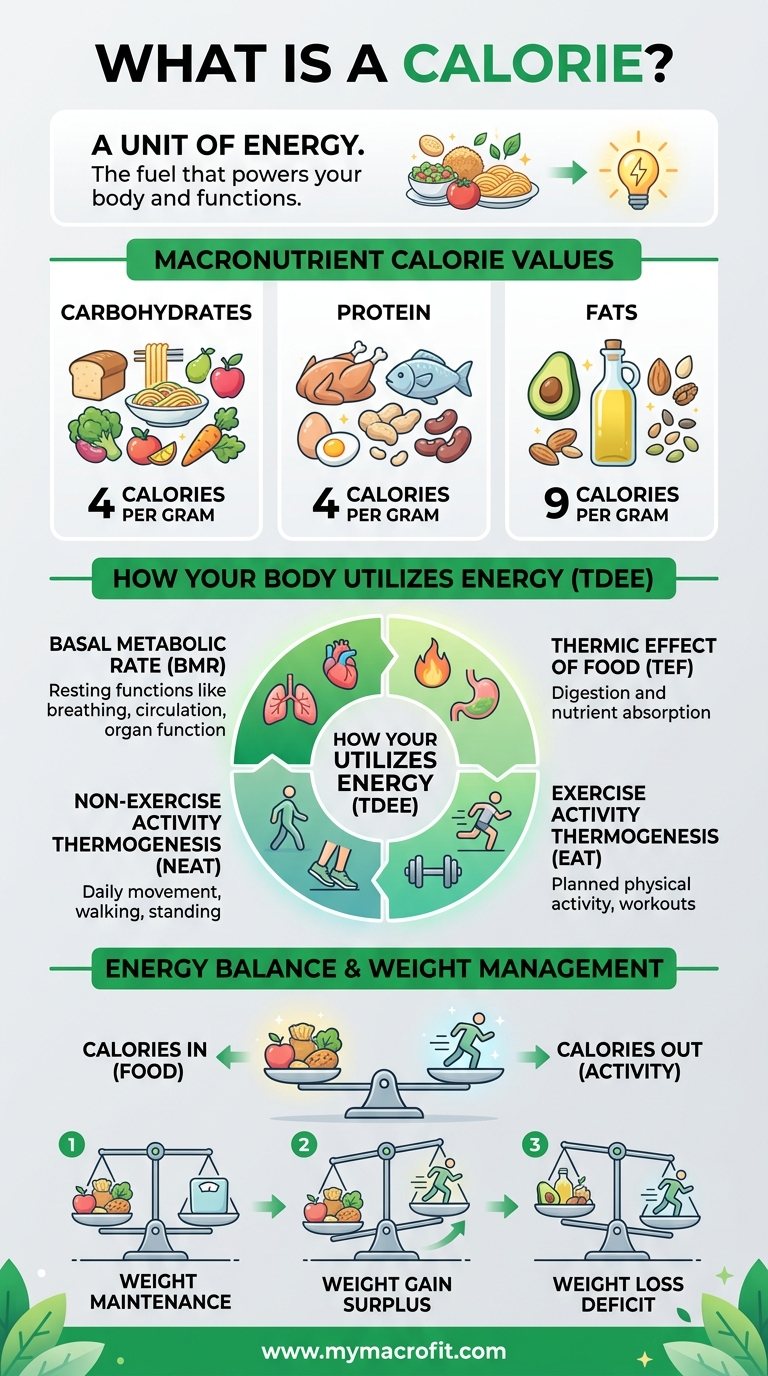
A calorie, technically a kilocalorie (kcal) in nutrition, is a unit of energy. Specifically, it's the amount of thermal energy needed to raise the temperature of 1 kilogram of water by 1 degree Celsius.
Food scientists measure calories by burning food samples in a device called a bomb calorimeter and measuring the heat released. The calorie values on food labels come from this type of testing.
Your body uses calories differently than a bomb calorimeter, digestive efficiency varies between foods, and some calories are used for different purposes, but the underlying principle is the same: food contains stored chemical energy, and your body releases that energy.
Where Calories Come From in Food
Only four components of food provide calories:
| Macronutrient | Calories per gram |
|---|---|
| Carbohydrates | 4 kcal/g |
| Protein | 4 kcal/g |
| Fat | 9 kcal/g |
| Alcohol | 7 kcal/g |
Water, fibre (largely), vitamins, and minerals provide no calories.
This is why fat-dense foods (butter, oil, nuts, chocolate) have high calorie counts per gram, fat provides more than double the energy of carbohydrates or protein for the same weight.
How Your Body Uses Calories
Your body's calorie usage breaks down into three components:
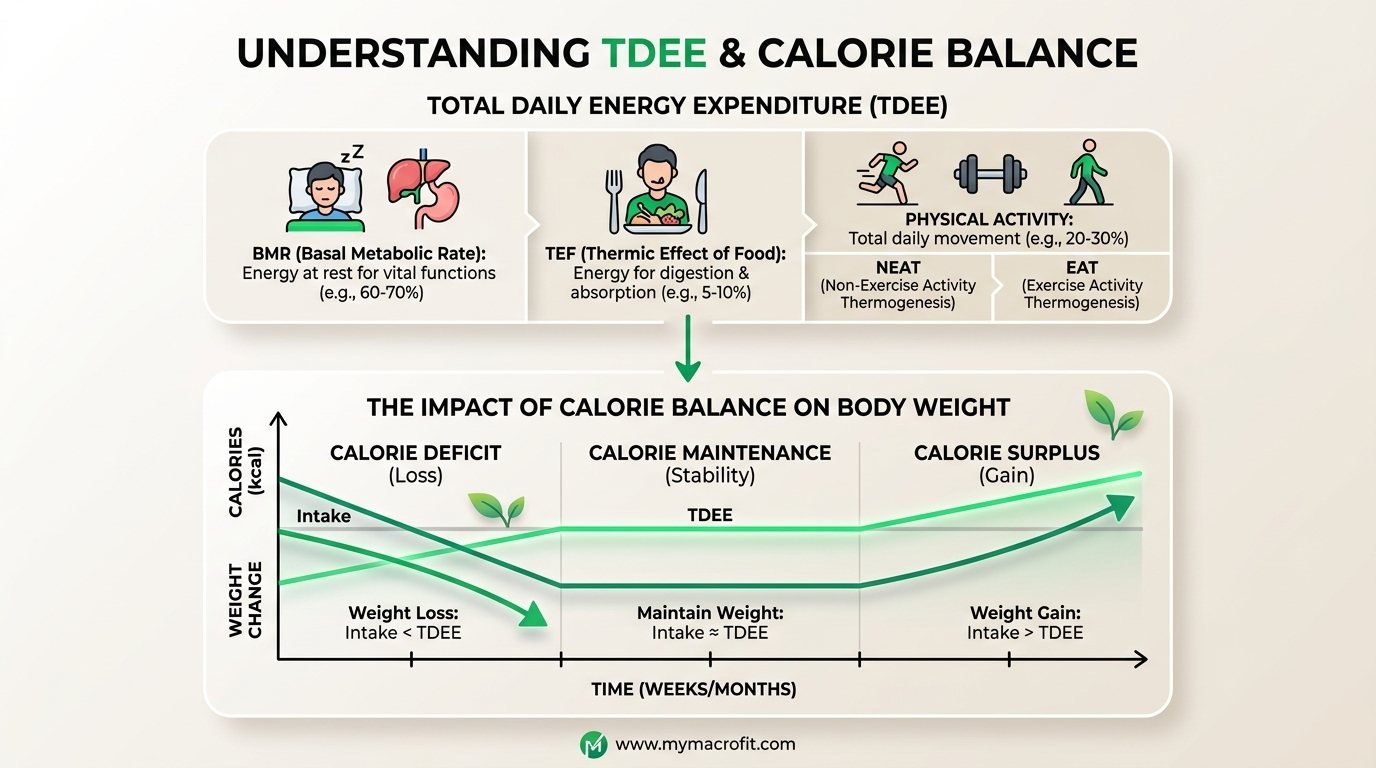
Basal Metabolic Rate (BMR): The energy used to keep you alive while at complete rest, breathing, heartbeat, brain function, organ maintenance. For most people, BMR accounts for 60-70% of total calorie expenditure.
Thermic Effect of Food (TEF): Energy used to digest and metabolise food. Different macronutrients have different TEF: protein 25-30%, carbohydrates 5-10%, fat 2-3%. This means your body actually burns some of the calories in food just by digesting it.
Physical Activity (NEAT + Exercise): All movement, from formal exercise to fidgeting, walking, and typing. This component varies most between individuals and is the most controllable.
Your TDEE (Total Daily Energy Expenditure) is the sum of all three, the total calories you burn in a day. Use our TDEE Calculator to estimate yours.
Calorie Balance and Body Weight
The fundamental principle of body weight:
Calorie deficit (eating less than TDEE): Body draws on stored energy (fat, some muscle) → weight loss
Calorie balance (eating ≈ TDEE): Weight maintenance
Calorie surplus (eating more than TDEE): Excess energy stored (primarily as fat) → weight gain
This isn't a theory, it's a thermodynamic principle. It applies to every human body.
What confuses people:
The scale fluctuates day-to-day from water retention, food weight, and glycogen changes, these aren't changes in body fat. True fat loss and gain occurs gradually over weeks from sustained calorie imbalance, not from a single day or meal.
How Many Calories Are in Common Foods?
Getting an intuition for calorie density is one of the most useful practical nutrition skills:
| Food | Portion | Calories |
|---|---|---|
| Olive oil | 1 tbsp (14g) | 120 kcal |
| Almonds | Small handful (30g) | 173 kcal |
| Banana | 1 medium (120g) | 107 kcal |
| Chicken breast | 150g cooked | 248 kcal |
| Whole milk | 250ml | 163 kcal |
| Broccoli | 200g | 68 kcal |
| Brown rice | 200g cooked | 260 kcal |
| Cheddar cheese | 30g | 124 kcal |
Notice how drastically calorie density varies. 200g of broccoli = 68 kcal; 30g of cheese = 124 kcal. The cheese portion weighs 6× less but contains 1.8× more calories.
Calories vs. Food Quality
A common debate: "Are calories all that matter?"
The answer is nuanced:
- For weight (fat mass) changes: Calorie balance is the primary determinant
- For body composition (muscle vs. fat ratio): Protein intake and training are critical alongside calorie balance
- For health, hunger, and hormones: Food quality matters enormously
You could theoretically lose weight eating only biscuits (if in a deficit), but you'd be hungry, nutrient-deficient, and losing muscle alongside fat. Combining calorie awareness with food quality produces the best outcomes for weight, body composition, and health.
The Bottom Line
A calorie is a unit of energy. Your body needs a certain number each day (your TDEE) to maintain weight. Consistently eating less than TDEE causes fat loss; consistently eating more causes fat gain. Understanding this is the foundation of any effective nutrition approach.
Use our TDEE Calculator to establish your baseline and start making informed decisions about your calorie intake.
Save & share on Pinterest
Click any card to pin it — or share with someone who needs it.
What Is a Calorie? (The Beginner's Complete Answer)
A clear, practical explanation of what a calorie is, how your body uses them, and what calorie balan…
A clear, practical explanation of what a calorie is, how your body uses them, an…
Read the full guide: What Is a Calorie? (The Beginner's Complete Answer)
Try the free TDEE Calculator
What Is a Calorie? (The Beginner's Complete Answer) — use our free calculators for instant personali…
Pinterest opens in a new tab. You can edit the description before saving.
Ready to get your numbers?
Free calculator, instant results, no signup required.
Frequently Asked Questions
What is a calorie in simple terms?+
How many calories do I need per day?+
Are all calories the same?+
How many calories are in protein, carbs, and fat?+
Do I have to count calories to lose weight?+
About the Author

I'm a kinesiologist and personal trainer. I've spent eight years helping women lose fat and get stronger without handing their whole life over to a diet.
View full profile →