Why Your TDEE Calculator Is Wrong (and How to Fix It)

CN · Metabolic Health Coach
Here's something no calculator will tell you up front: the TDEE number it just gave you is almost certainly a little wrong. Not useless, wrong by a margin. Understanding why, and how to correct it, is the difference between spinning your wheels and actually hitting your goal. The fix isn't a better calculator; it's a simple feedback loop.
Calculators estimate, they can't measure
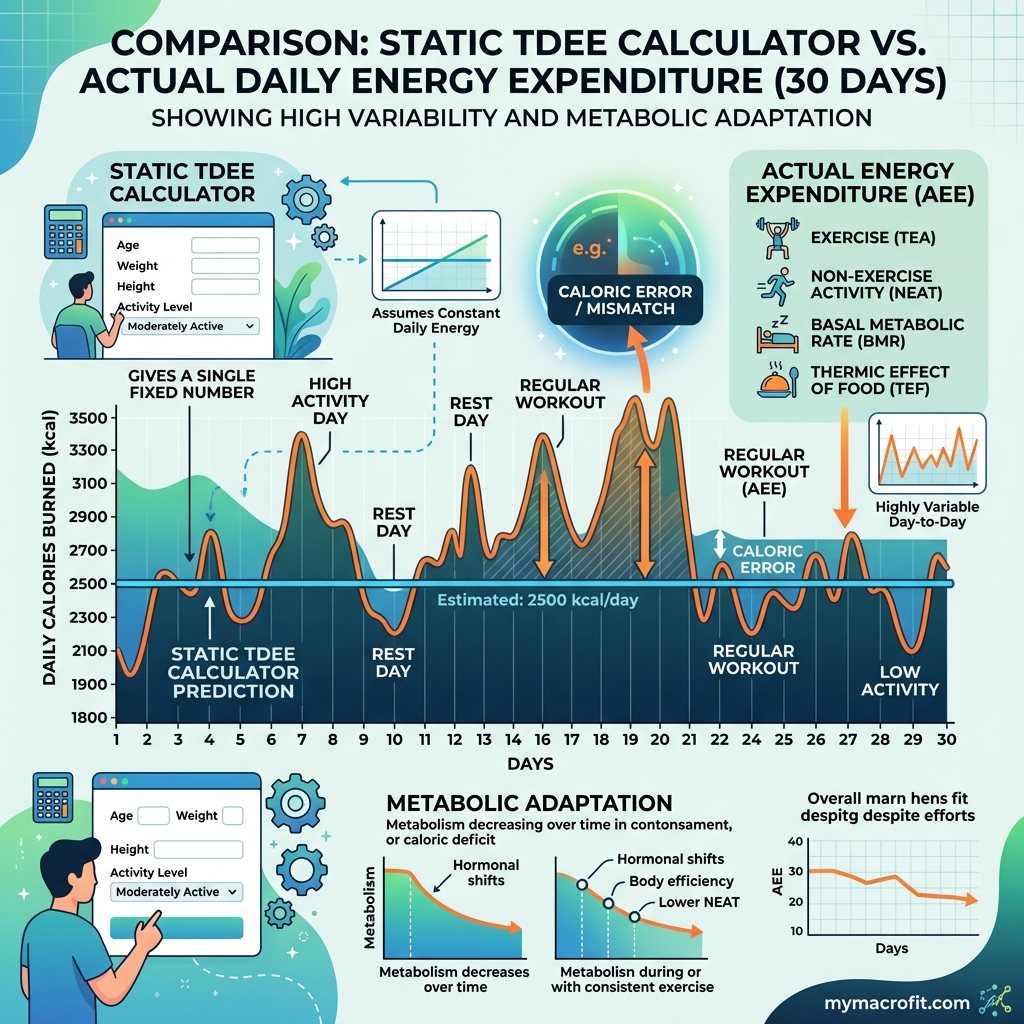
A TDEE calculator uses a population equation (Mifflin-St Jeor) plus an activity multiplier. Those are averages. They can't see your individual metabolism, your muscle mass, how much you fidget, how efficiently your gut absorbs food, or your hormones. For most healthy adults the estimate lands within 5-10% of reality, excellent for a starting point, but a 10% miss on a 2,500-calorie maintenance is 250 calories, easily enough to stall fat loss.
The big sources of error
| Source of error | Effect | Why |
|---|---|---|
| Activity level over-picked | TDEE too high | The multiplier scales your whole BMR (most common error) |
| NEAT variation | ±100-400 cal/day | Incidental movement isn't captured well |
| Muscle mass | Formula guesses it | More muscle = higher burn than the equation assumes |
| Untracked intake | "Deficit" isn't real | Oils, drinks, bites, portion drift |
| Water weight | Masks the scale | Hides real fat loss for days/weeks |
The first and the second-to-last rows cause the vast majority of "the calculator is wrong / I'm not losing weight" cases, and notice one is about the estimate and one is about your intake. Both have to be honest.
The fix: estimate, then calibrate
You don't find your true TDEE by hunting for a better formula. You find it by testing the estimate against reality:
- Get the estimate. Run the TDEE Calculator and note the number.
- Eat at it consistently for 2-3 weeks, tracking intake honestly and your average weekly weight.
- Read the result. Weight stable → that intake is your real TDEE. Slowly gaining → your true TDEE is a bit lower. Slowly losing → it's a bit higher.
- Adjust and lock it in. Now you have a TDEE based on your data, not a population average.
Start with the best estimate.
Get your TDEE, then calibrate it against two weeks of real data.
Calculate My TDEE →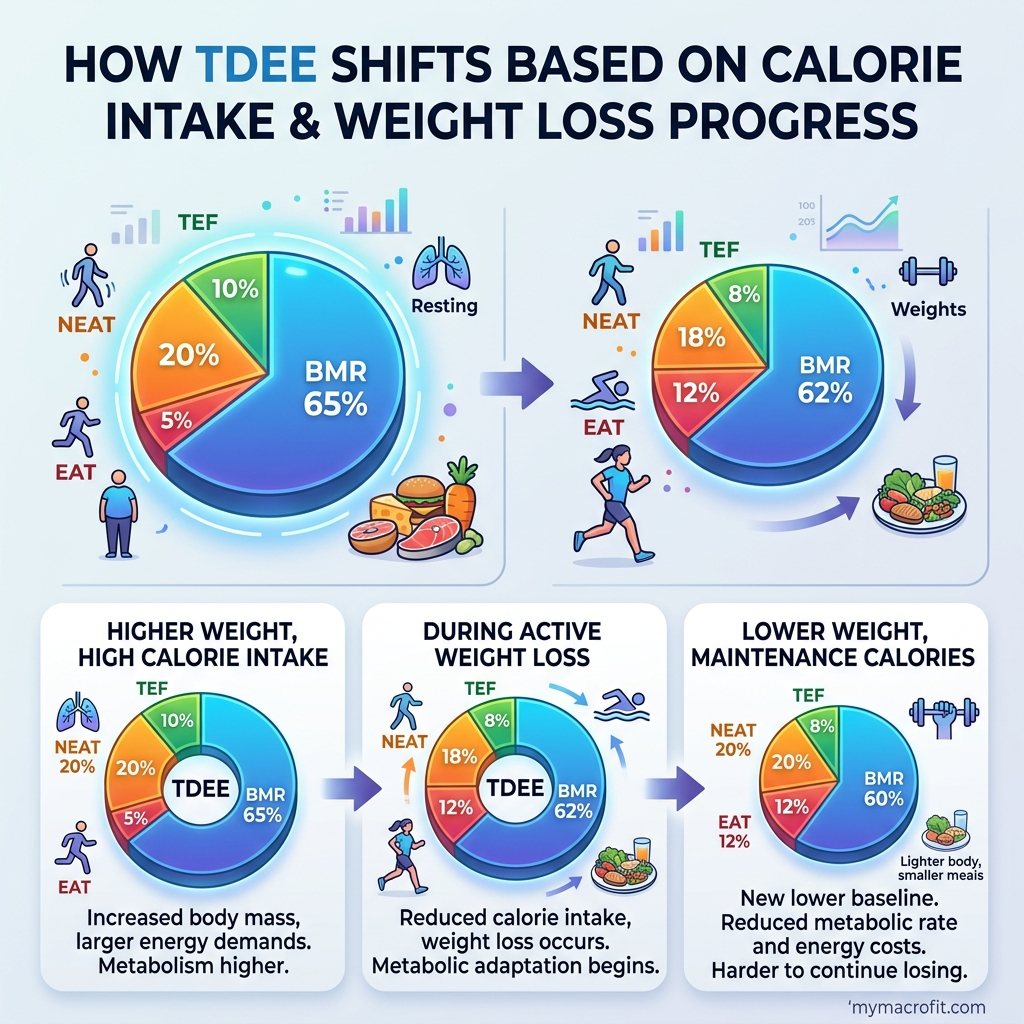
A worked calibration, with actual numbers
Theory is cheap. Here's what the feedback loop looks like in practice.
Say the calculator estimates your TDEE at 2,400. You set a fat-loss target of 1,900 (a 500-calorie deficit) and predict roughly 0.45kg of loss per week. You eat at 1,900, track honestly, and weigh daily for three weeks. Your weekly averages:
- Week 1: 80.1kg
- Week 2: 80.0kg
- Week 3: 79.9kg
That's 0.2kg in three weeks, not the ~1.3kg you predicted. So the maths is off somewhere. Working backwards: losing ~0.07kg/week means an actual deficit of only about 75 calories a day, not 500. Your real TDEE is closer to 1,975, not 2,400. The calculator overshot by over 400 calories, almost certainly an over-picked activity level plus some untracked intake.
Now you know your number. Drop to a genuine deficit from 1,975, and the scale finally moves. That's the entire game: the calculator gave you a starting bet, three weeks of data corrected it.
Why you can't trust a few days
Metabolism and bodyweight are noisy. NEAT swings daily, the thermic effect of food varies with what you eat, and water weight can hide fat loss for a week or more, which is why a few flat days mean nothing. Always judge over a 2-3 week average. (And be skeptical of your smartwatch's calorie burn, wearables are frequently off, especially for lifting.)
Then keep it current
Even a perfectly calibrated TDEE drifts as you lose fat or build muscle, a lighter body burns less. Recalculate and recalibrate every 4-5kg or so. An out-of-date TDEE is the quiet killer of an otherwise good plan; see how to adjust macros when weight loss stalls.

Stop hunting for the perfect formula
Your TDEE calculator isn't lying, it's estimating, and estimates have error bars. The professionals' trick is simple: take the number as a hypothesis, test it against 2-3 weeks of honest tracking, and adjust to your real data. Do that and "the calculator is wrong" stops being a problem. Start with the TDEE Calculator.
People waste weeks bouncing between calculators looking for the one that's "accurate." There isn't one, because the error isn't in the formula, it's in the things no formula can see: your NEAT, your absorption, the calories you didn't log. The good news is you don't need a better calculator. You need three weeks and a notebook. The feedback loop beats any equation, every time.
Save & share on Pinterest
Click any card to pin it — or share with someone who needs it.
Why Your TDEE Calculator Is Wrong (and How to Fix It)
TDEE calculators give an estimate, not a fact, and several things throw them off. Here's why your nu…
TDEE calculators give an estimate, not a fact, and several things throw them off…
Read the full guide: Why Your TDEE Calculator Is Wrong (and How to Fix It)
Try the free TDEE Calculator
Why Your TDEE Calculator Is Wrong (and How to Fix It) — use our free calculators for instant persona…
Pinterest opens in a new tab. You can edit the description before saving.
Ready to get your numbers?
Free calculator, instant results, no signup required.
Frequently Asked Questions
How accurate are TDEE calculators?+
Why am I not losing weight if I'm eating below my TDEE?+
How do I find my real TDEE?+
Does metabolism vary day to day?+
Should I trust a fitness tracker's calorie burn over a TDEE calculator?+
Does your TDEE drop as you diet, beyond just weighing less?+
About the Author

I'm a certified nutritionist and metabolic health coach. I went deep on keto and metabolism after reversing my own insulin resistance, and I'd rather give you the actual numbers than a hand-wave.
View full profile →