TDEE Calculator for Men: Find Your Maintenance Calories (Cut, Bulk, Maintain)

BSc Kinesiology · CPT
Most men's nutrition advice skips the only number that actually matters: how many calories you burn in a day. That's your TDEE, Total Daily Energy Expenditure, and whether you want to cut, bulk, or maintain, it's the figure everything else is built on. Calculate it once and the rest of your diet becomes simple arithmetic. Here's how.
What TDEE means
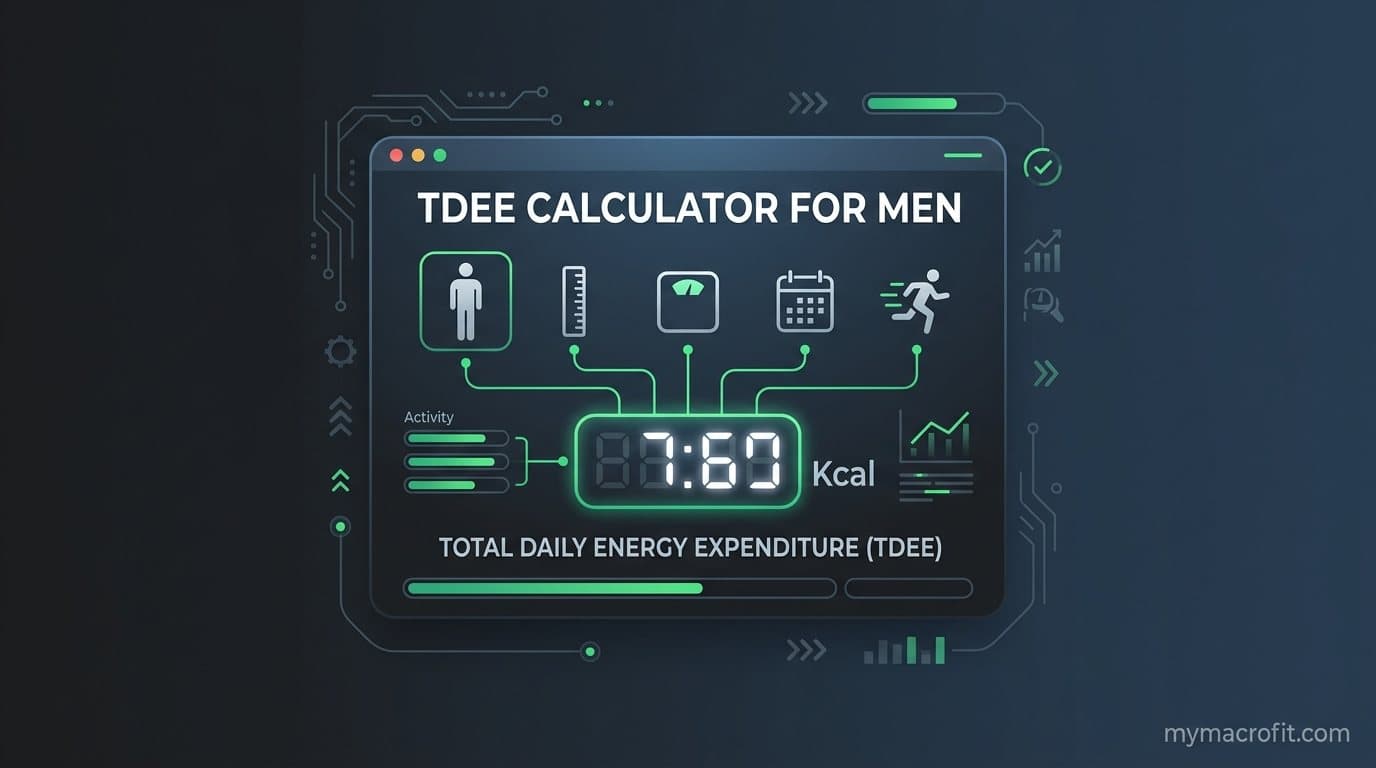
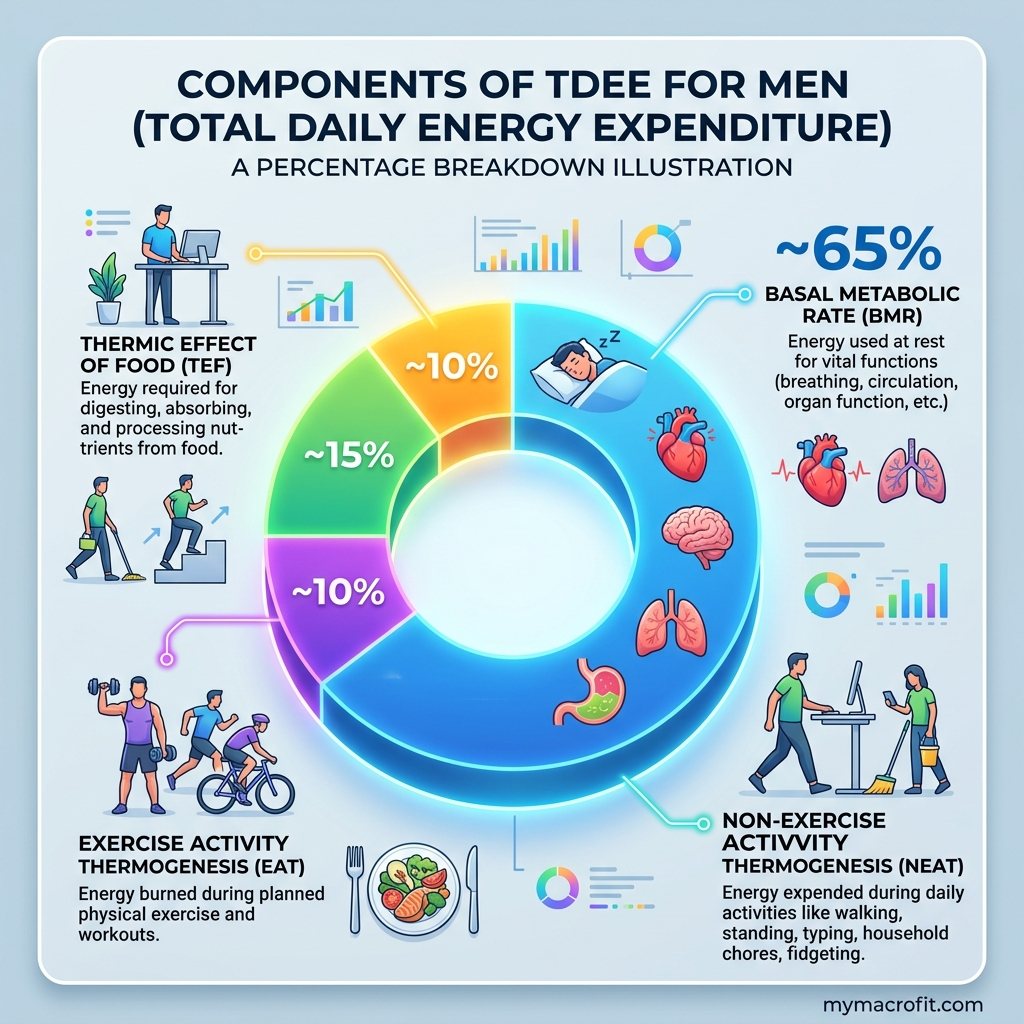
Your TDEE is your maintenance, eat that and your weight holds. It's your Basal Metabolic Rate (resting burn) multiplied by an activity factor for movement and training. Eat below it to lose fat; eat above it to build. The TDEE Calculator works it out from your age, height, weight, and activity using the Mifflin-St Jeor equation, the most accurate general formula for healthy adults.
Why men's maintenance runs higher
On average, men carry more muscle and have a larger body size, and muscle burns calories even at rest, so male TDEE tends to be higher. The equation captures this with a sex-specific term. Remember it's an average, not a guarantee: your real number depends on your size, activity, and muscle, which is exactly why you calculate it rather than assume.
Find your maintenance calories.
The free TDEE Calculator gives you a personalised number, the starting point for any goal.
Calculate My TDEE →Turn your TDEE into a goal
Once you have your maintenance number, every goal is a simple adjustment:
| Goal | Target | Example (TDEE 2,700) |
|---|---|---|
| Cut (fat loss) | TDEE − 15-25% | ~2,000-2,300 cal |
| Maintain | TDEE | ~2,700 cal |
| Lean bulk | TDEE + ~10% | ~3,000 cal |
For fat loss, the Calorie Deficit Calculator sets the deficit; for gaining, the Lean Bulk Calculator sets the surplus. Then split either target with the Macro Calculator, keeping protein at 1.6-2.2g/kg.
Rough TDEE by weight and activity
Calculate your own number for accuracy, but it helps to see the ballpark so you can sense-check the result. These are rough maintenance figures for men of average height in their 30s:
| Bodyweight | Lightly active | Moderately active | Very active |
|---|---|---|---|
| 70 kg | ~2,300 | ~2,550 | ~2,800 |
| 80 kg | ~2,500 | ~2,800 | ~3,050 |
| 90 kg | ~2,700 | ~3,000 | ~3,300 |
| 100 kg | ~2,900 | ~3,250 | ~3,550 |
If the calculator hands you a number wildly different from your row here, you've probably picked the wrong activity level. That's the cue to drop it a notch.
A worked example, start to finish
Take Sam: 85kg, 180cm, 34, trains three or four times a week with a desk job. The calculator puts his BMR near 1,850 and, at a lightly-to-moderately active setting, his TDEE around 2,700.
From that one number, his whole plan falls out:
- Wants to cut? 2,700 minus 20% is about 2,150 calories. At roughly 170g protein, that's a steady half-kilo-a-week loss without feeling starved.
- Wants to bulk? 2,700 plus 10% is about 2,970 calories, enough to build with minimal fat gain.
- Happy where he is? He eats around 2,700 and keeps protein high to slowly recomp.
Notice he didn't need three different calculators to start. He needed his TDEE and a single percentage. That's the whole point of getting this number first.
The activity level trap
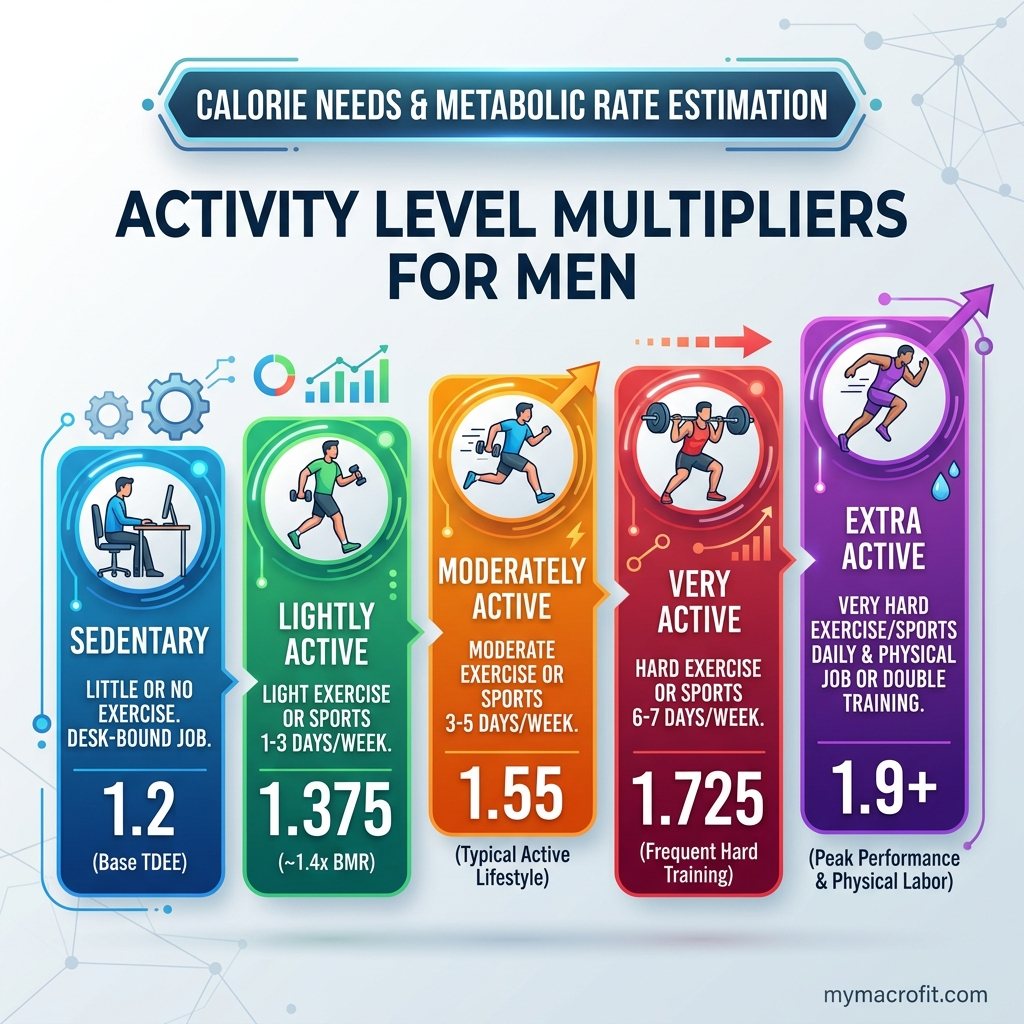
The single biggest error men make isn't the equation, it's overestimating activity. A few gym sessions a week is usually "lightly" to "moderately" active, not "very active." Picking too high an activity level inflates your TDEE and quietly wipes out your deficit. When in doubt, choose the lower setting and adjust from real results. There's a full breakdown in the activity level multiplier guide.
Keep it current
Your TDEE isn't fixed. As you lose fat or add muscle, it shifts, so recalculate every 4-5kg of change or every month or so during an active phase. An out-of-date maintenance number is the most common reason a cut stalls or a bulk gets sloppy. More on that in why your TDEE is wrong.

Your first move
For any man with a goal, the first move is simple: calculate your TDEE, then adjust it, down to cut, up to bulk, hold to maintain. Be honest about your activity level, keep protein high, and recalculate as your body changes. Start with the TDEE Calculator.
Do it now, before you plan a single meal. Two minutes with the calculator gives you the one number that turns "how much should I eat?" from a guess into a calculation. Write it down, pick your percentage, and you've got a target you can actually train and eat against.
Save & share on Pinterest
Click any card to pin it — or share with someone who needs it.
TDEE Calculator for Men: Find Your Maintenance Calories (Cut, Bulk, Maintain)
Your TDEE is the one number every man's diet should start from. Here's how to calculate it, why men'…
Your TDEE is the one number every man's diet should start from. Here's how to ca…
Read the full guide: TDEE Calculator for Men: Find Your Maintenance Calories (Cut, Bulk, Maintain)
Try the free TDEE Calculator
TDEE Calculator for Men: Find Your Maintenance Calories (Cut, Bulk, Maintain) — use our free calcula…
Pinterest opens in a new tab. You can edit the description before saving.
Ready to get your numbers?
Free calculator, instant results, no signup required.
Frequently Asked Questions
How many calories does the average man burn per day?+
Why is men's TDEE usually higher than women's?+
How many calories should a man eat to lose weight?+
How many calories should a man eat to build muscle?+
How often should men recalculate TDEE?+
Does a man's TDEE drop a lot with age?+
About the Author

I'm a kinesiologist and personal trainer. I've spent eight years helping women lose fat and get stronger without handing their whole life over to a diet.
View full profile →