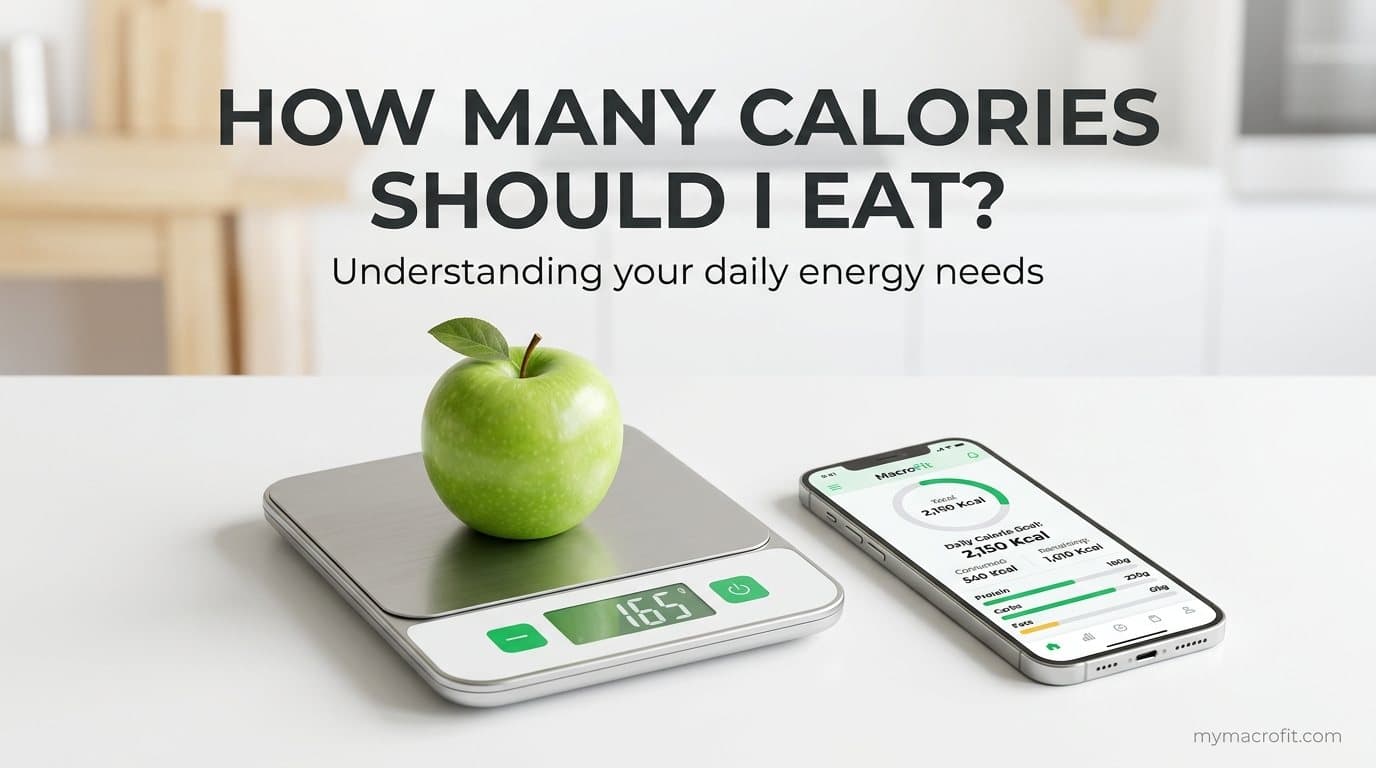
How Many Calories Should I Eat Per Day? (By Goal and Body Type)

BSc Kinesiology · CPT
"How many calories should I eat?" might be the question I've been asked most in eight years of coaching, and I love it, because it's exactly the right place to start. But here's what I always tell women who ask me: the honest answer is "it depends entirely on you," and anyone who gives you a flat number without knowing your body is guessing. A petite, desk-based woman might maintain her weight beautifully on 1,600 calories. A tall, active man might need 3,200 to hold the same weight. "Just eat 2,000 calories" helps neither of them.
The good news is that finding your number isn't complicated, it's a short calculation you can do today. This guide walks you through it, shows you how to adjust it for your goal, and (the part most articles skip) how to actually live with it.
Step 1: Calculate Your BMR
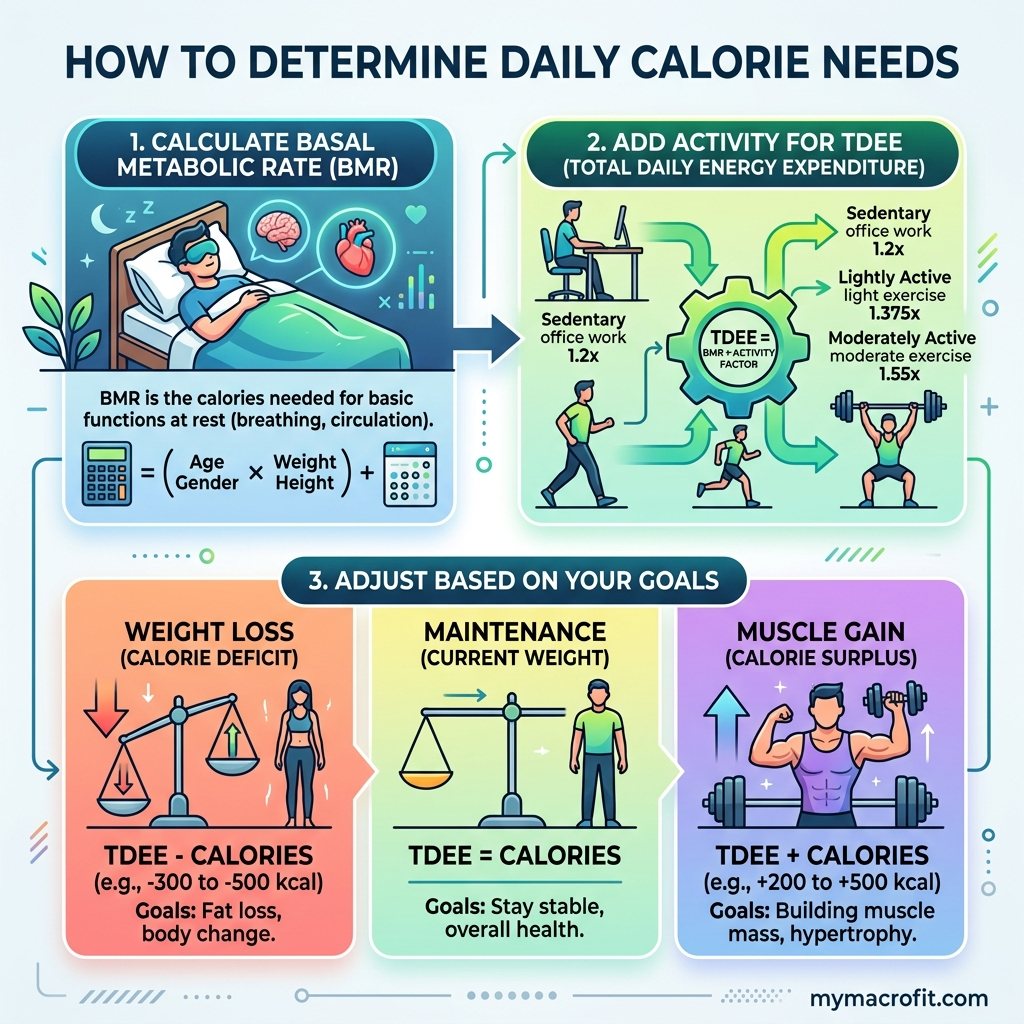
Basal Metabolic Rate (BMR) is the number of calories your body burns at complete rest, just to keep your heart beating, lungs breathing, and organs functioning. It accounts for roughly 60-70% of total calorie burn.
Mifflin-St Jeor equation (most accurate):
For women: BMR = (10 × weight kg) + (6.25 × height cm) − (5 × age) − 161
For men: BMR = (10 × weight kg) + (6.25 × height cm) − (5 × age) + 5
Example, 30-year-old woman, 65kg, 165cm: BMR = (10 × 65) + (6.25 × 165) − (5 × 30) − 161 = 650 + 1,031 − 150 − 161 = 1,370 kcal
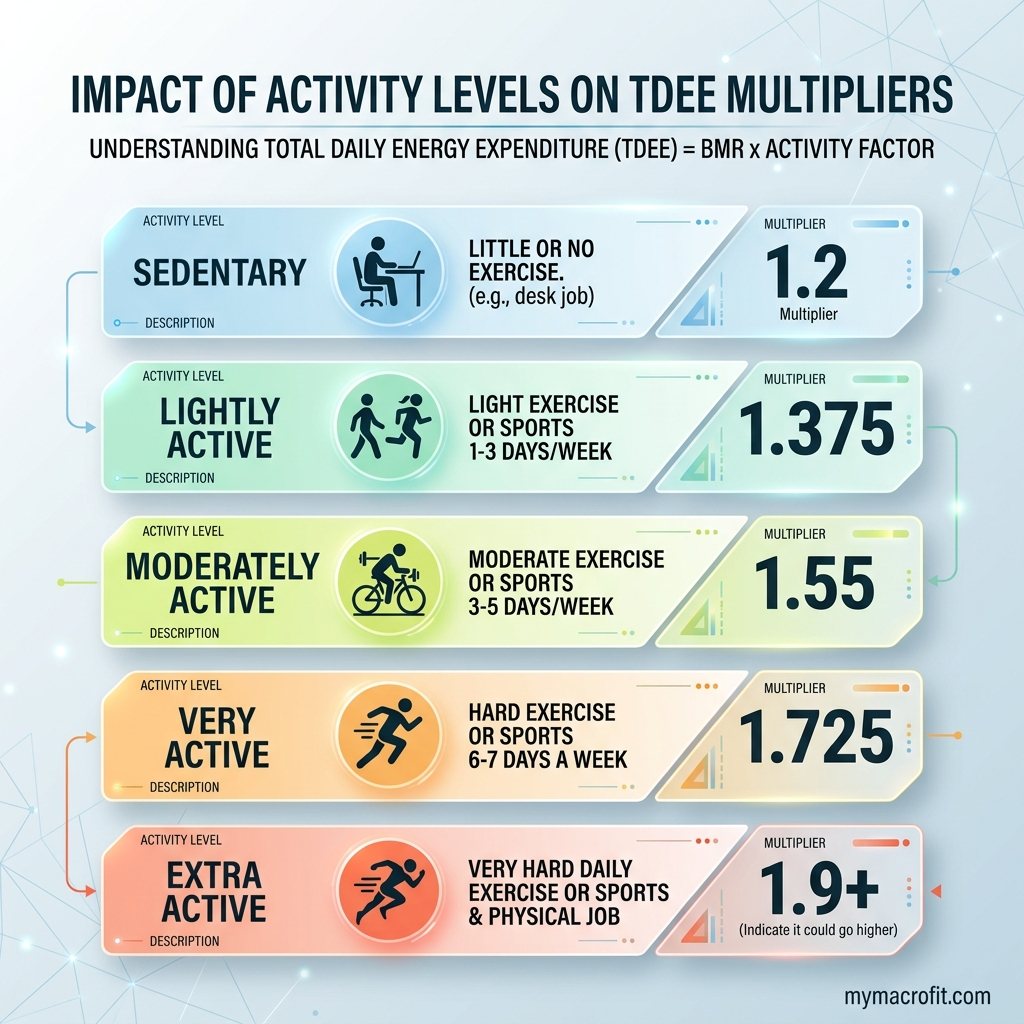
Step 2: Multiply by Your Activity Level (TDEE)
Your TDEE (Total Daily Energy Expenditure) is your actual daily calorie burn, BMR adjusted for how active you are.
| Activity Level | Description | Multiplier |
|---|---|---|
| Sedentary | Desk job, little or no exercise | × 1.2 |
| Lightly active | Light exercise 1-3 days/week | × 1.375 |
| Moderately active | Moderate exercise 3-5 days/week | × 1.55 |
| Very active | Hard exercise 6-7 days/week | × 1.725 |
| Extremely active | Physical job + hard exercise daily | × 1.9 |
Continuing the example, moderately active: TDEE = 1,370 × 1.55 = 2,124 kcal/day (maintenance)
Step 3: Adjust for Your Goal
Once you know your TDEE, the adjustment is straightforward:
| Goal | Calorie target | Expected result |
|---|---|---|
| Aggressive fat loss | TDEE − 750 kcal | ~0.7kg/week (includes some muscle loss) |
| Moderate fat loss | TDEE − 500 kcal | ~0.5kg/week (mostly fat) |
| Gentle fat loss | TDEE − 300 kcal | ~0.25kg/week (sustainable, minimal muscle loss) |
| Maintenance | TDEE | Weight stable |
| Lean muscle gain | TDEE + 200 kcal | ~0.2-0.4kg/month lean mass |
| Faster muscle gain | TDEE + 350-500 kcal | ~0.4-0.8kg/month (some fat gain) |
For our example woman targeting moderate fat loss: 1,624 − 500 = 1,624 kcal/day
Real-World Reference Calorie Ranges
While individual needs vary, these ranges cover the majority of adults:
Women
| Goal | Typical range |
|---|---|
| Fat loss | 1,300-1,700 kcal |
| Maintenance | 1,700-2,200 kcal |
| Muscle building | 1,900-2,500 kcal |
Men
| Goal | Typical range |
|---|---|
| Fat loss | 1,700-2,300 kcal |
| Maintenance | 2,200-2,900 kcal |
| Muscle building | 2,500-3,500 kcal |
These are starting points, individual variation can be 30% in either direction.
Why "Eat 2,000 Calories" Is Often Wrong
The 2,000 kcal daily reference was set in the 1990s for food labelling purposes based on average estimates. It:
- Is too high for many sedentary women (their TDEE may be 1,700-1,800 kcal)
- Is too low for active men (who may need 2,500-3,000 kcal at maintenance)
- Doesn't account for body composition (a muscular person burns more at rest)
- Doesn't adjust for goal
Your number is yours. Calculate it properly and use it.
How to Track Your Calories
- Use a food scale, measuring cups are inaccurate for calorie-dense foods (1 tablespoon of peanut butter can be 80 kcal or 180 kcal depending on how generous you are)
- Use an app, MyFitnessPal, Cronometer, or MacroFactor have large food databases with barcode scanning
- Track for 2-4 weeks, after this period, most people develop accurate portion intuition and can relax the tracking
What If the Calculation Isn't Working?
If you're eating at your calculated target but not seeing expected results:
Not losing weight despite being at a calculated deficit:
- Your TDEE calculation may be overestimated (common with fitness trackers)
- Tracking may have creep errors, weigh food for one week with a scale
- Your actual activity level may be lower than selected
Losing weight too fast (>1kg/week):
- Your deficit is likely larger than intended
- Increase calories by 150-200 kcal, prioritise from carbohydrates
- Ensure protein is at minimum 1.6g/kg to protect muscle
Not gaining muscle despite eating above maintenance:
- Check that protein is 1.6-2.2g/kg
- Progressive overload in training is the primary driver, nutrition supports it
- If gaining fat too fast, reduce surplus to 150-200 kcal above TDEE
The Bottom Line
Your daily calorie needs = BMR × activity multiplier (TDEE). Subtract 300-500 kcal to lose fat, add 200-350 kcal to build muscle, or maintain at TDEE.
Use the TDEE Calculator to get your personalised number in 60 seconds, no manual maths required.
Sources
- Comparison of predictive equations for resting metabolic rate, Frankenfield et al., Journal of the American Dietetic Association, 2005
- Energy balance and its components, Hall et al., American Journal of Clinical Nutrition, 2012
- NHS: Understanding calories, NHS, 2023
Save & share on Pinterest
Click any card to pin it — or share with someone who needs it.
How Many Calories Should I Eat Per Day? (By Goal and Body Type)
Find out exactly how many calories you should eat to lose fat, build muscle, or maintain weight, wit…
Find out exactly how many calories you should eat to lose fat, build muscle, or …
Read the full guide: How Many Calories Should I Eat Per Day? (By Goal and Body Type)
Try the free TDEE Calculator
How Many Calories Should I Eat Per Day? (By Goal and Body Type) — use our free calculators for insta…
Pinterest opens in a new tab. You can edit the description before saving.
Ready to get your numbers?
Free calculator, instant results, no signup required.
Frequently Asked Questions
How many calories should I eat to lose weight?+
How do I calculate my daily calorie needs?+
Is 1,200 calories enough per day?+
How many calories do I need to maintain my weight?+
How many calories should I eat to build muscle?+
Why am I not losing weight even though I'm eating few calories?+
About the Author

I'm a kinesiologist and personal trainer. I've spent eight years helping women lose fat and get stronger without handing their whole life over to a diet.
View full profile →