Macro Split Guide: 40/30/30 vs 35/35/30 vs Keto, Which Ratio Is Right?

CN · Metabolic Health Coach
Open any fitness forum and you'll trip over numbers like "40/30/30" and "35/35/30" thrown around as if they're secret codes. They're just percentage splits of your daily calories across carbs, protein, and fat. This guide decodes the common ones, tells you who each suits, and then explains why the ratio you obsess over matters far less than two simpler numbers.
What the numbers mean
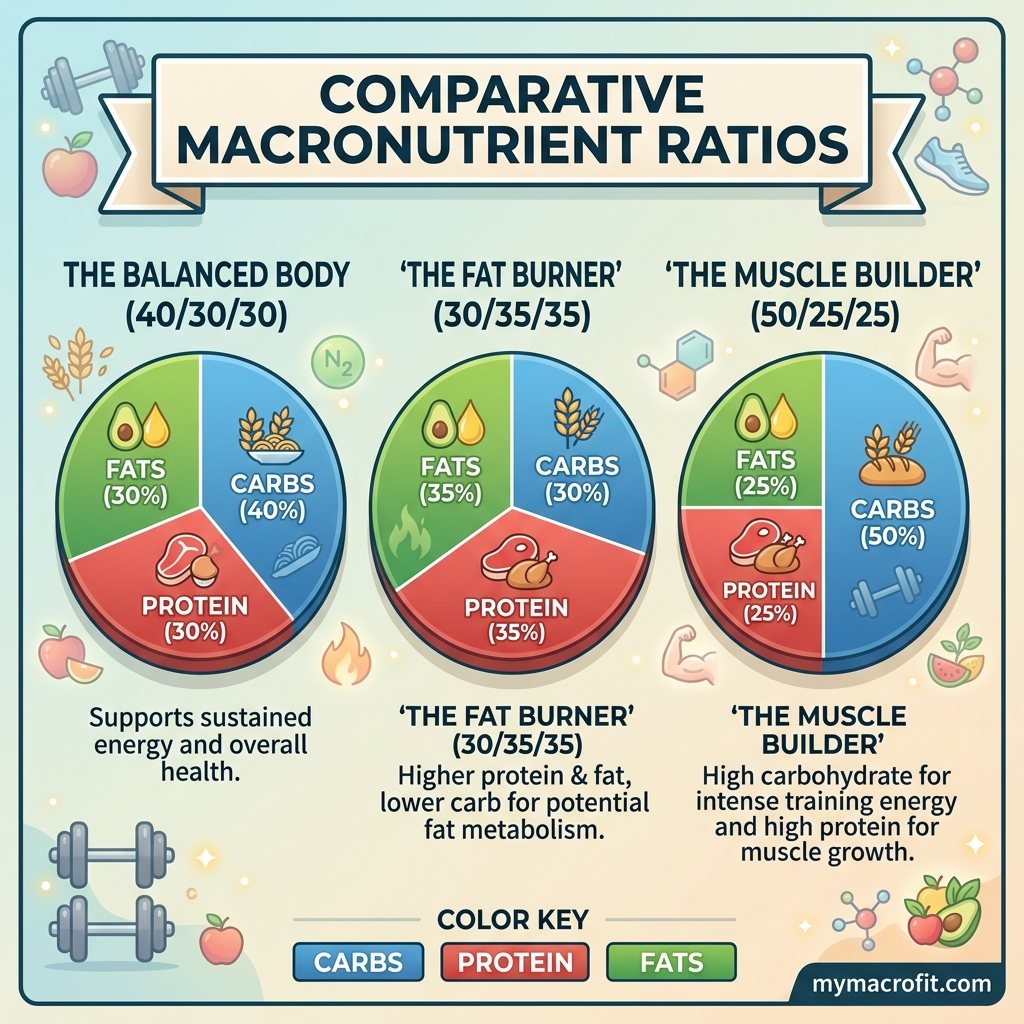
A macro split is the share of your daily calories coming from each macronutrient. Because protein and carbs have 4 calories per gram and fat has 9, a percentage split translates into very different gram amounts. Here are the splits you'll actually encounter:
| Split (C/P/F) | Name / use | Best for |
|---|---|---|
| 40 / 30 / 30 | Balanced ("Zone") | General fitness, maintenance |
| 35 / 35 / 30 | Higher-protein | Fat loss, body recomposition |
| 30 / 40 / 30 | High-protein, moderate carb | Active fat loss, athletes |
| 50 / 25 / 25 | Higher-carb | Endurance, heavy training |
| 5 / 25 / 70 | Keto (F/P/C reversed) | Low-carb preference, appetite control |
(C = carbs, P = protein, F = fat. Keto is conventionally written fat-first because fat dominates.)
The splits that suit fat loss
For losing fat, you want protein high, so the 35/35/30 and 30/40/30 style splits win, because the extra protein protects muscle and keeps you full in a deficit. That's the logic behind the standard weight-loss macro split. A balanced 40/30/30 still works; it just gives up a little of protein's edge.
The splits that suit muscle and performance
When you're training hard or building muscle, carbs earn their keep, they fuel intense sets and recovery. Higher-carb splits like 50/25/25 (or simply keeping protein at a gram target and letting carbs run high) support performance better than a low-carb approach.
Keto: the outlier
The ketogenic split (~70% fat, 25% protein, 5% carbs) is the deliberate opposite, slashing carbs to push the body into ketosis. It suits people who feel better low-carb or want powerful appetite suppression, but at equal calories and protein it isn't magically better for fat loss. If you're going keto, the Keto Macro Calculator gives you the exact grams.
Stop guessing percentages.
The free Macro Calculator turns your goal into exact gram targets, no ratio math required.
Calculate My Macros →The plot twist: percentages are the wrong starting point
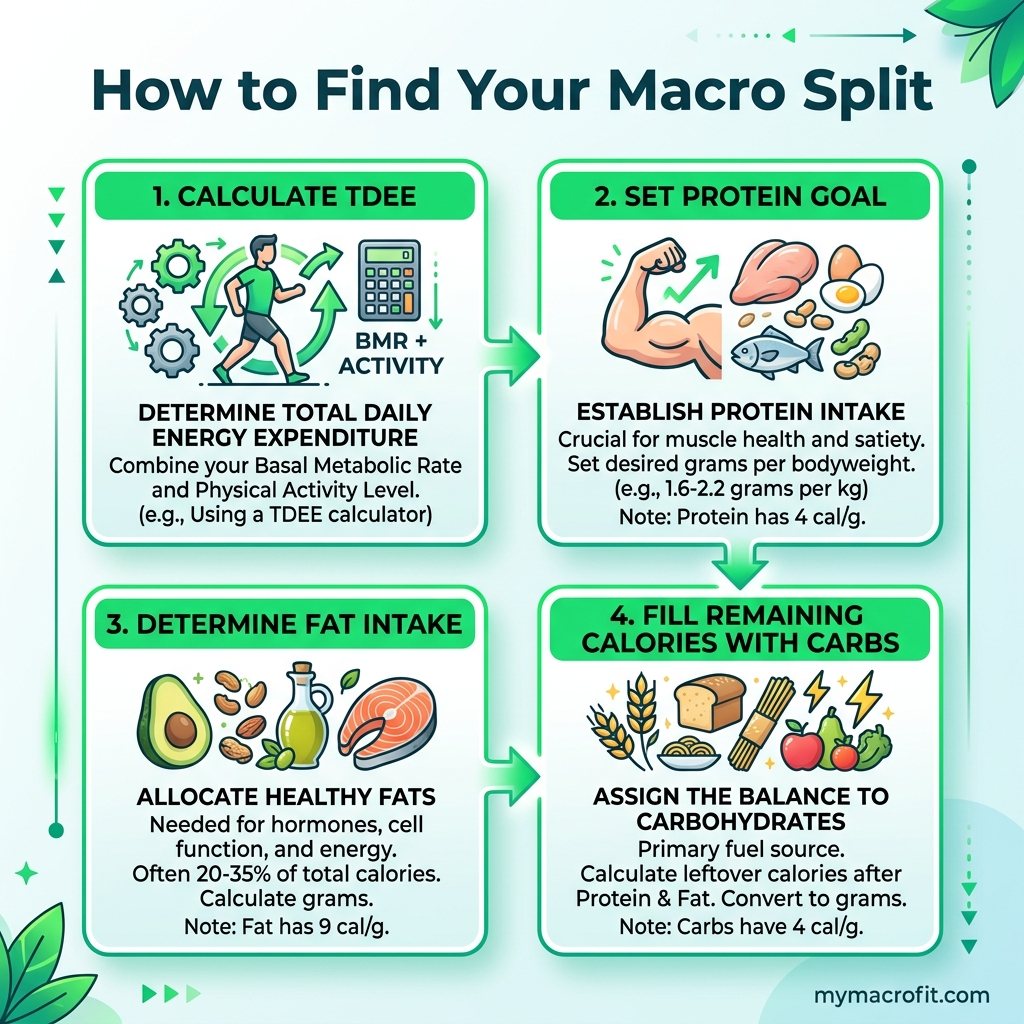
Here's the data-driven reality. Percentages of calories don't know how big you are, 30% protein means something very different for a 55kg and a 95kg person. That's why coaches set macros in grams per kilogram of bodyweight, not percentages:
- Protein first, 1.6-2.2g/kg (the number that protects muscle).
- Fat next, 0.8-1g/kg (the floor for hormones and satiety).
- Carbs last, whatever calories remain.
Do that and your "split" simply falls out of the math. The percentage is a result, not a target. This is exactly how the Macro Calculator works, and why it beats picking a ratio off a chart.

What the same calories look like as grams
Let me show you why the percentage is a distraction. Take an 80kg person eating 2,000 calories. Set protein and fat as gram targets first, and watch the "split" appear on its own:
| Step | Target | Calories |
|---|---|---|
| Protein, 2.0g/kg | 160g | 640 |
| Fat, 0.9g/kg | 72g | 648 |
| Carbs, the rest | ~178g | 712 |
Run the percentages and that lands at roughly 36% carbs / 32% protein / 32% fat, basically a 35/35/30 split. You never picked it. It fell out of two gram targets and a calorie ceiling. That's the whole point: get protein and calories right and the ratio is just arithmetic afterward.
The mistake: optimising the thing that barely matters
I see people agonise for weeks over whether they should run 40/30/30 or 30/40/30 while their actual protein is a coin flip day to day and they've never weighed their food. That's optimising the 5% problem while ignoring the 95% problem.
Here's the honest priority order, and it's not close:
- Calories. Decides whether you gain, lose, or hold. Everything else is noise without this.
- Protein. Decides whether the weight you change is muscle or fat.
- Fibre and food quality. Decides whether you feel good and stay full.
- The carb-to-fat split. Preference and performance. Pick what you enjoy.
If you're debating splits before you've nailed the first two, you're rearranging deck chairs. Lock calories and protein, then tune the split to how you like to eat and train.
Let the split take care of itself
40/30/30, 35/35/30, keto, they're useful shorthand, not rules. Total calories decide weight change; protein decides whether you keep muscle; the carb-to-fat balance is mostly preference and performance. Set protein and fat as gram targets, let carbs fill the rest, and the perfect "split" takes care of itself. Get yours from the Macro Calculator.
Save & share on Pinterest
Click any card to pin it — or share with someone who needs it.
Macro Split Guide: 40/30/30 vs 35/35/30 vs Keto, Which Ratio Is Right?
Confused by macro ratios like 40/30/30? Here's what each common split means, who it suits, and why t…
Confused by macro ratios like 40/30/30? Here's what each common split means, who…
Read the full guide: Macro Split Guide: 40/30/30 vs 35/35/30 vs Keto, Which Ratio Is Right?
Try the free Macro Calculator
Macro Split Guide: 40/30/30 vs 35/35/30 vs Keto, Which Ratio Is Right? — use our free calculators fo…
Pinterest opens in a new tab. You can edit the description before saving.
Ready to get your numbers?
Free calculator, instant results, no signup required.
Frequently Asked Questions
What does 40/30/30 mean in macros?+
Is 40/30/30 or 35/35/30 better for fat loss?+
Do macro percentages actually matter?+
What's the keto macro split?+
Should I set macros by percentage or by grams per kilo?+
How do I choose between more carbs or more fat once protein is set?+
About the Author

I'm a certified nutritionist and metabolic health coach. I went deep on keto and metabolism after reversing my own insulin resistance, and I'd rather give you the actual numbers than a hand-wave.
View full profile →