Macros by Body Weight: Protein, Carb and Fat Targets Chart

BSc Kinesiology · CPT
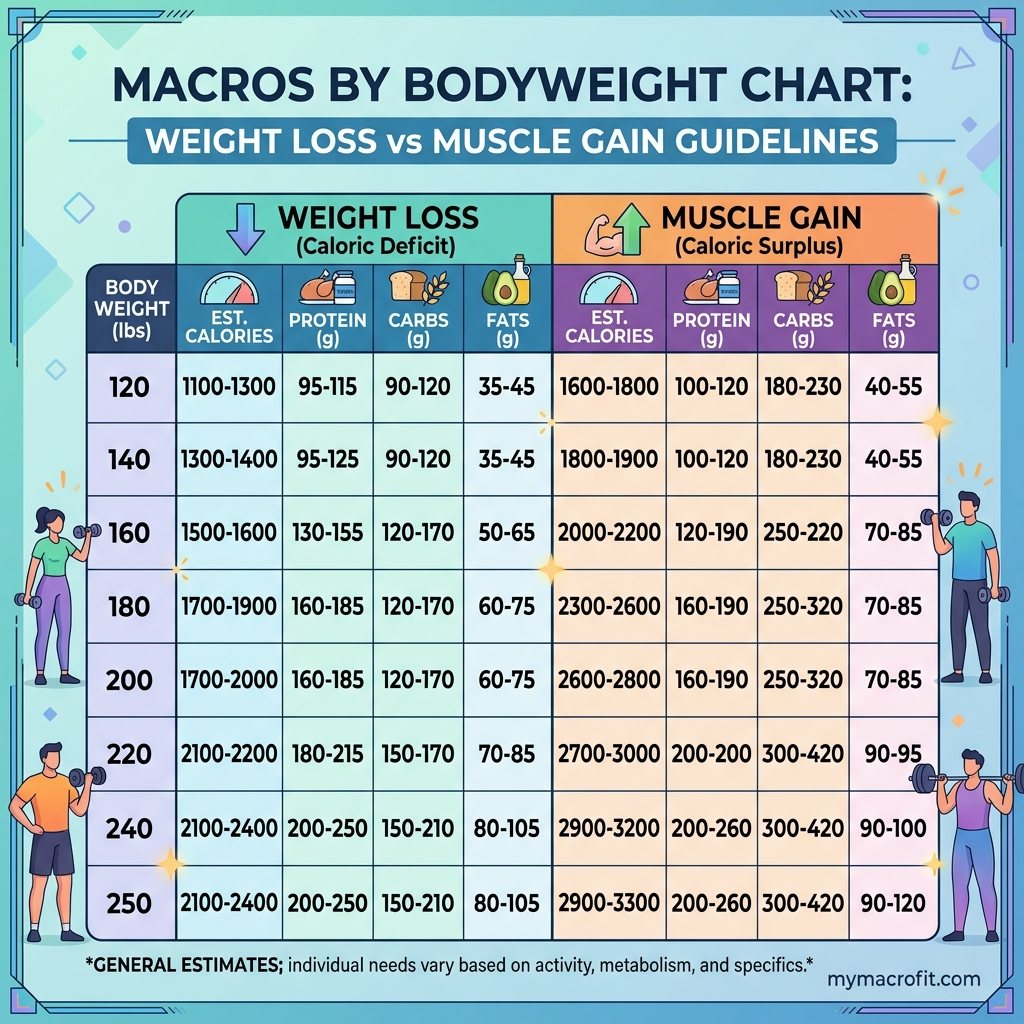
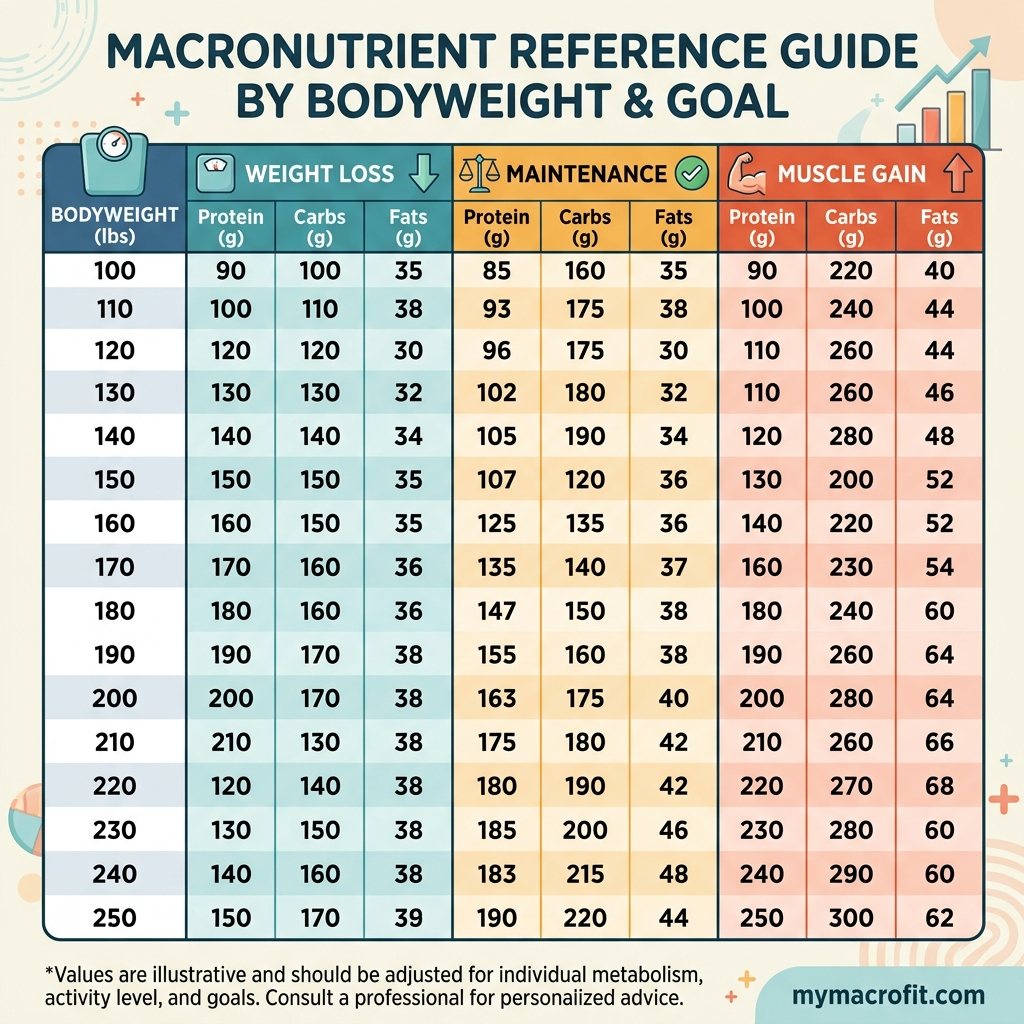
If you want a quick reference instead of a formula, this is it: a chart of daily macro targets by bodyweight, for three common goals. It's built on the same evidence-based rules coaches use, protein and fat scaled to your weight, carbs filling the rest. Use it as a starting point, then personalise it with the calculator for your exact calories and activity.
How the chart is built
The targets below set protein at ~2.0g/kg (fat loss) or ~1.8g/kg (maintenance/gain), fat at ~0.9g/kg, and carbs filling the remaining calories for each goal's typical calorie level. They assume moderate activity, adjust up if you train hard, down if you're sedentary.
Macros by bodyweight, fat loss
| Bodyweight | Calories (approx) | Protein | Fat | Carbs |
|---|---|---|---|---|
| 55 kg | ~1,500 | 110g | 50g | ~130g |
| 70 kg | ~1,750 | 140g | 63g | ~140g |
| 85 kg | ~2,050 | 170g | 77g | ~155g |
| 100 kg | ~2,300 | 200g | 90g | ~165g |
Macros by bodyweight, maintenance
| Bodyweight | Calories (approx) | Protein | Fat | Carbs |
|---|---|---|---|---|
| 55 kg | ~1,900 | 100g | 53g | ~250g |
| 70 kg | ~2,300 | 126g | 68g | ~300g |
| 85 kg | ~2,650 | 153g | 82g | ~340g |
| 100 kg | ~3,000 | 180g | 97g | ~380g |
Macros by bodyweight, muscle gain
| Bodyweight | Calories (approx) | Protein | Fat | Carbs |
|---|---|---|---|---|
| 55 kg | ~2,150 | 99g | 53g | ~330g |
| 70 kg | ~2,600 | 126g | 68g | ~410g |
| 85 kg | ~3,000 | 153g | 82g | ~470g |
| 100 kg | ~3,400 | 180g | 97g | ~540g |
These are estimates, get your exact numbers.
The chart assumes average activity. The free Macro Calculator personalises calories and macros to you.
Calculate My Macros →How to use the chart
- Find your row by bodyweight and your goal.
- Adjust for activity, add carbs if you train hard or have a physical job; trim them if you're mostly sedentary, since the calorie estimates assume moderate activity.
- Treat protein as a floor you hit most days; it's the number that protects muscle. Confirm it with the Protein Calculator.
- Recalculate as you change, every 4-5kg, your weight-based targets and calorie needs shift.
Why grams per kilo, not percentages
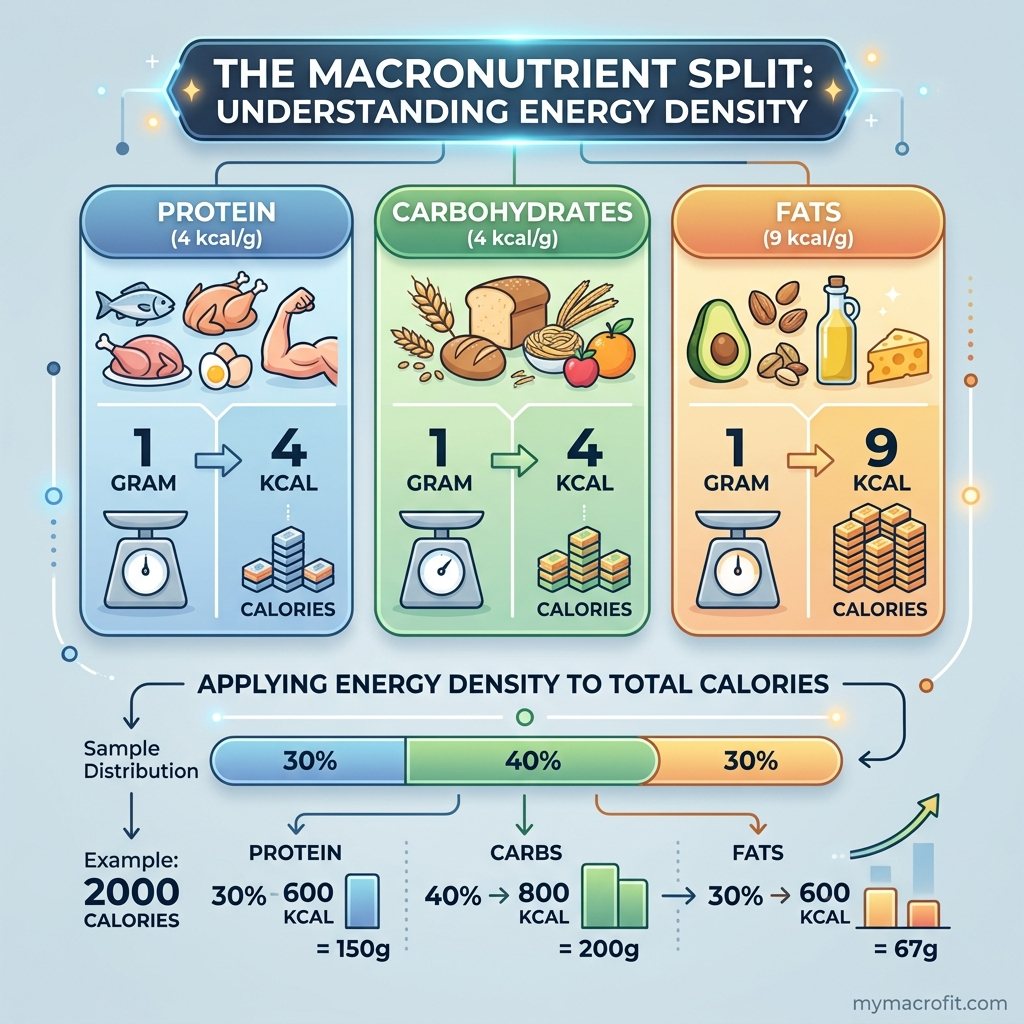
A chart like this works because it scales to you. Percentage splits (like 40/30/30) ignore body size, so the same percentage gives a tiny person and a large person wildly different protein. Setting protein and fat per kilogram of bodyweight, then filling the rest with carbs, is more accurate and is exactly how the Macro Calculator and the macro split guide approach it.
Adjusting the chart for your activity, a worked example
The chart assumes moderate activity, so the honest answer to "which row is mine?" is it depends on how much you move. Here's how I'd walk a client through it.
Say you're 70kg and your goal is fat loss. The chart points you to roughly 1,750 calories, 140g protein, 63g fat, and 140g carbs. Now layer in your real week:
- Desk job, two gym sessions: the estimate is about right. Start here.
- On your feet all day, or training five times a week: you'll burn more, so add 30-50g of carbs (around 120-200 calories) to fuel the work, otherwise fat loss can feel brutal and your lifts suffer.
- Mostly sedentary, no structured exercise: trim 20-30g of carbs so the deficit is real rather than theoretical.
Protein and fat barely move in that example, carbs do most of the adjusting. That's deliberate: protein guards muscle and fat keeps your hormones happy, so they stay anchored while carbs flex with your activity. After two weeks, let the scale and the mirror decide whether you nudge calories further.
Common mistakes with weight-based macros
I see the same few slip-ups again and again:
- Treating the numbers as exact. They're a starting point, not a prescription. Your real needs depend on age, height, and how much you genuinely move, none of which a chart can see.
- Eating the muscle-gain row while wanting to lose fat. Sounds obvious, but it's easy to drift toward the bigger numbers because they're more fun to eat. Match the row to the goal you actually have today.
- Never recalculating. Targets that fit at 85kg are too high at 75kg. Re-check every 4-5kg of change.
- Chasing the carb and fat grams to the decimal. Hit protein, land calories in range, and stop stressing about whether you ate 60g or 68g of fat. Adherence beats precision every time.
Who should use goal weight or lean mass instead
For most people, current bodyweight is the simplest accurate input, and it's what I'd default to. There's one group I adjust for: if you're carrying a large amount of excess fat, basing protein on your current weight can spit out a number that's higher than you need and harder to eat. In that case, base protein on your goal weight or an estimate of lean mass instead. A 120kg person targeting 80kg, for example, is better served aiming protein at roughly 80-90kg of bodyweight than at 120. If that's you, the protein intake guide walks through the adjustment, or let the Macro Calculator handle it.
Where to go from here
Use the chart for a fast, reasonable starting point by bodyweight and goal. But your real calorie needs depend on age, height, and activity the chart can't see, so personalise with the Macro Calculator and adjust from real-world results. For the full method, see how to calculate your macros, and if you're still deciding which numbers matter most, the macro split guide breaks down protein, carbs, and fat one at a time.
Your one next step today: find your row, write down the three numbers, and track them for a week before you change anything. Real-world results from your own body beat any chart.
Save & share on Pinterest
Click any card to pin it — or share with someone who needs it.
Macros by Body Weight: Protein, Carb and Fat Targets Chart
A simple chart of daily macro targets by bodyweight for fat loss, maintenance, and muscle gain, plus…
A simple chart of daily macro targets by bodyweight for fat loss, maintenance, a…
Read the full guide: Macros by Body Weight: Protein, Carb and Fat Targets Chart
Try the free Macro Calculator
Macros by Body Weight: Protein, Carb and Fat Targets Chart — use our free calculators for instant pe…
Pinterest opens in a new tab. You can edit the description before saving.
Ready to get your numbers?
Free calculator, instant results, no signup required.
Frequently Asked Questions
How do I calculate macros from my body weight?+
How much protein per kg of body weight should I eat?+
Why use grams per kilo instead of percentages?+
Do these macro targets change as I lose weight?+
Should I use my current weight or goal weight for macros?+
What if I hit my protein but not my carbs or fat?+
About the Author
I'm a kinesiologist and personal trainer. I've spent eight years helping women lose fat and get stronger without handing their whole life over to a diet.
View full profile →