How to Gain Weight Fast the Healthy Way

BSc Kinesiology · CPT
Some people struggle with the opposite problem of most: they're underweight or a "hardgainer" who finds it difficult to add mass despite eating what feels like a lot. Whether you're trying to build muscle, recover from illness, or simply reach a healthy weight, gaining mass requires a systematic approach, not just eating more of everything indiscriminately.
Understanding Why You're Not Gaining Weight
Before discussing how to gain weight, it's worth understanding why some people genuinely struggle:
High NEAT: Some people have very high non-exercise activity thermogenesis, they naturally move more, fidget more, and burn significantly more calories through daily activity. TDEE for these individuals can be 2,500-3,500+ kcal/day, making a surplus harder to achieve.
Underestimating calories in/TDEE: Just as dieters often underestimate calorie intake, "hardgainers" often underestimate their TDEE. Tracking accurately for a week frequently reveals the actual surplus needed.
Poor protein distribution: Even with adequate total calories, insufficient protein (or poor distribution) limits muscle gain.
Training programme not optimised: Too much cardio relative to resistance training burns the surplus needed for muscle growth.
The Calorie Surplus
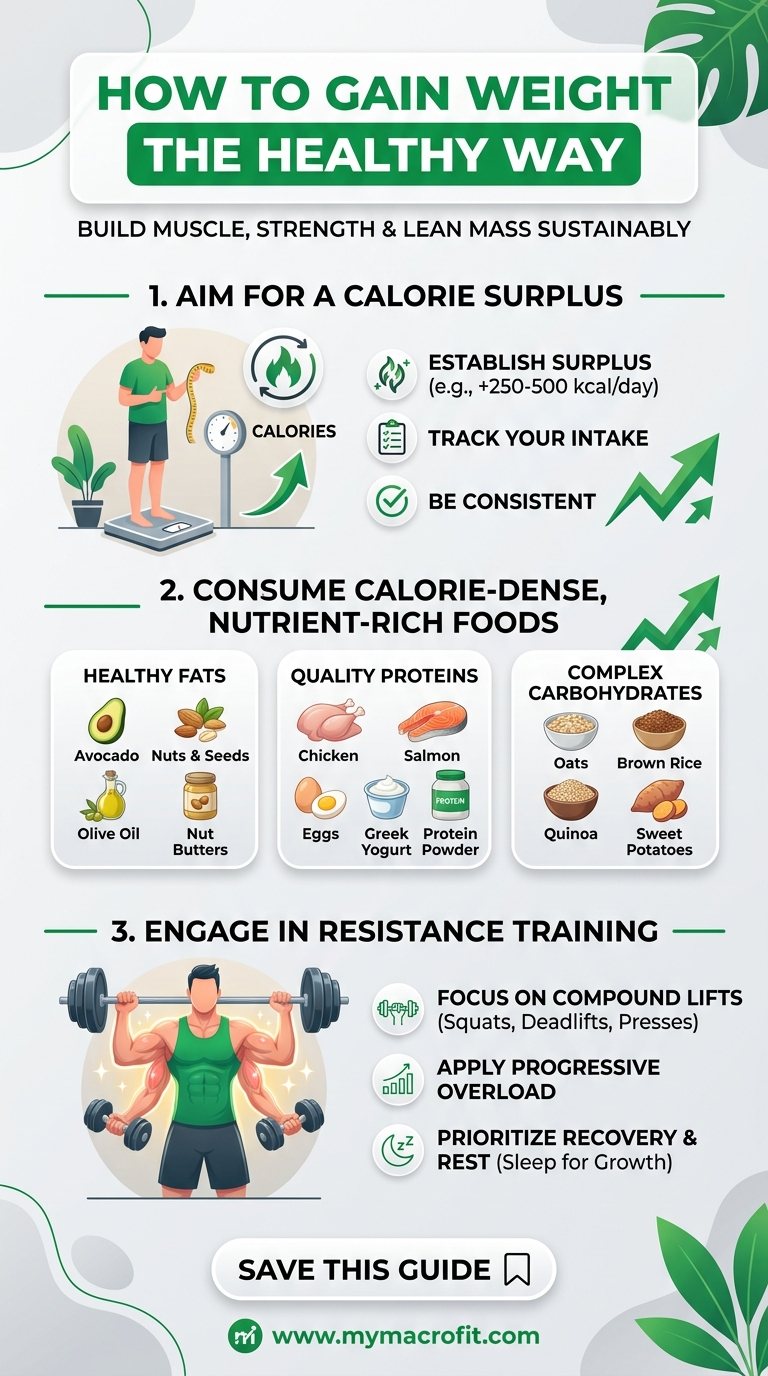
Lean bulk (recommended): +250-500 kcal above TDEE
This produces 0.2-0.5kg weight gain per week, mostly lean mass for people training consistently. Smaller, more controllable fat accumulation.
Aggressive bulk: +500-1,000 kcal above TDEE
Faster scale weight gain but higher fat gain proportion. Harder to maintain long-term.
"Dirty bulk" (avoid): +1,000+ kcal above TDEE
Rapid weight gain but most of it is fat, not muscle. Requires a subsequent extended cut that largely negates the time advantage.
Use our Lean Bulk Calculator to establish your specific surplus target.
Protein: The Priority Within the Surplus
Protein drives the muscle-gain component of weight gain. Regardless of total calories:
Target: 2-2.2g/kg bodyweight per day
For an 70kg person: 140-154g/day. This provides adequate amino acids for maximum muscle protein synthesis during the calorie surplus.
The critical point: Additional calories above TDEE without adequate protein increase fat storage without increasing muscle gain proportionally. More calories alone don't build more muscle, protein + adequate calories + training stimulus does.
Calorie-Dense, Nutritious Foods for Weight Gain
The challenge for people who struggle to eat enough: fitting a significant calorie surplus into meals without feeling perpetually stuffed.
The solution: calorie-dense foods that don't require large volumes
| Food | Calories | Easy additions |
|---|---|---|
| Whole milk | 149 kcal/250ml | Add to porridge, coffee, protein shakes |
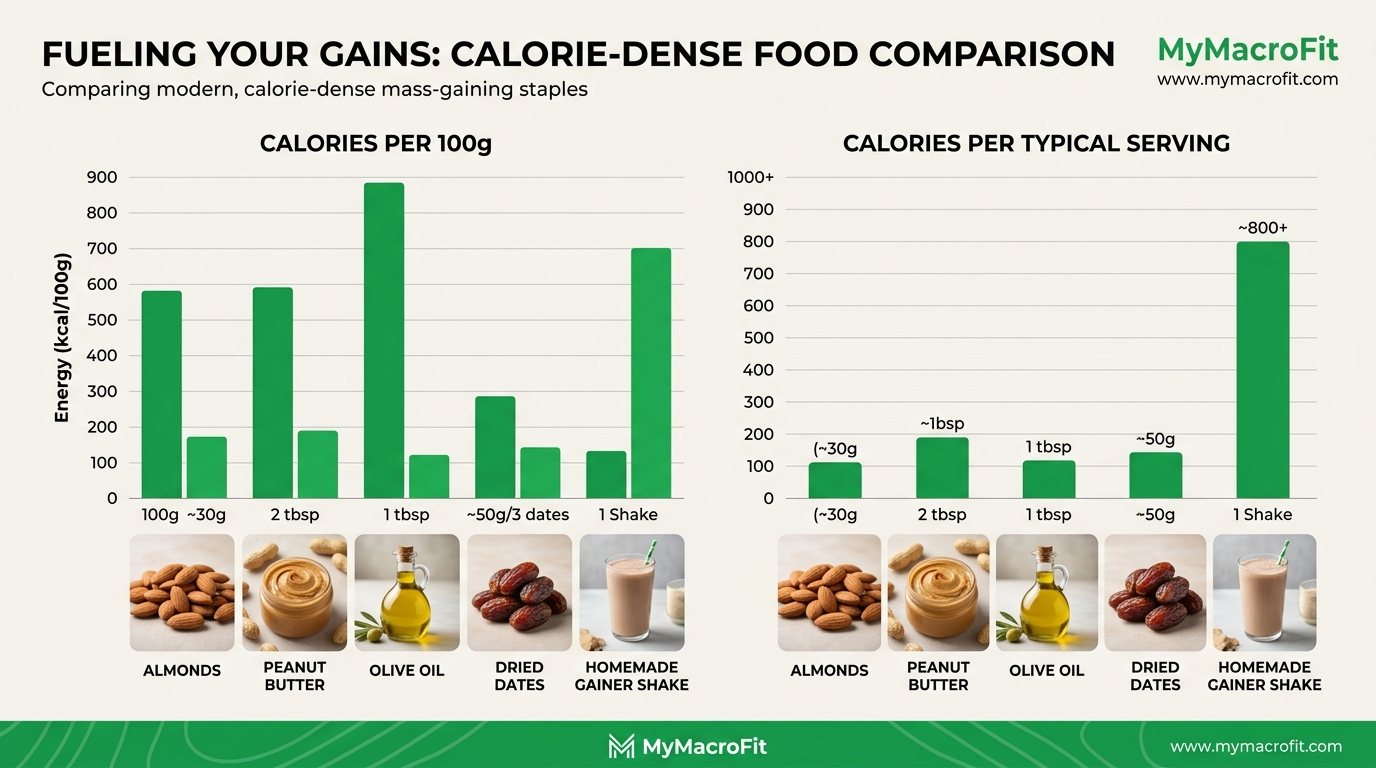
| Olive oil | 120 kcal/tbsp | Drizzle over everything |
| Nut butter | 95-100 kcal/tbsp | Add to oats, spread on bread |
| Whole eggs | 70-90 kcal/egg | Eat more eggs |
| Avocado | 160 kcal/half | Add to meals |
| Nuts | 160-180 kcal/30g | High-calorie snack |
| Full-fat Greek yogurt | 130 kcal/150g | Higher calorie than 0% |
| Oats | 380 kcal/100g dry | High volume calories |
| Banana | 110 kcal/medium | Easy calorie addition to shakes |
| Rice | 130 kcal/100g cooked | Calorie-efficient carbohydrate |
The mass gainer shake strategy:
Blend: 300ml whole milk + 1 scoop whey protein + 1 banana + 2 tbsp peanut butter + 40g oats = ~800 kcal, 50g protein. One shake per day adds the surplus without requiring a larger meal.
Training for Lean Gains
Diet alone produces fat gain. Diet + resistance training produces lean mass gain.
Programme requirements:
- 3-4 resistance training sessions per week
- Compound movements (squat, deadlift, press, row)
- Progressive overload, add weight consistently
- Adequate recovery between sessions
Cardio during a bulk: Keep to 1-2 moderate-intensity sessions of 30-40 minutes. More than this burns the surplus needed for muscle growth.
The 12-Week Lean Bulk Plan
Calculate your lean bulk calorie target: TDEE + 350 kcal/day
Track everything for the first 3 weeks, hardgainers are often surprised how little they were actually eating once they measure.
Assess at 4 weeks: Is scale weight increasing by 0.2-0.4kg/week? If not, add 100-150 kcal.
Maximum rate: If gaining faster than 0.5kg/week, reduce surplus slightly, faster gain is increasingly fat, not muscle.
Training: Follow the 12-week beginner strength programme or equivalent compound-focused approach.
Supplements for Weight Gain
Creatine monohydrate (3-5g/day): The most effective supplement for lean mass gain. See our creatine mechanism guide.
Protein powder (whey or plant-based): Practical tool for hitting protein targets when appetite or meal prep is limiting.
Mass gainers: Commercial mass gainer supplements (providing 600-1,200 kcal per serving) are effective for people who simply cannot eat enough. However, many contain excess sugar, making your own shake with whole food ingredients (the recipe above) is more nutritious and often cheaper.
The Bottom Line
Healthy weight gain requires: a moderate calorie surplus (250-500 kcal above TDEE), adequate protein (2g/kg), consistent resistance training with progressive overload, and minimised cardio volume. Track intake accurately first, most "hardgainers" discover they're not actually eating in a surplus when they measure.
Gain slowly (0.2-0.4kg/week) to maximise muscle:fat ratio. Faster isn't better.
Save & share on Pinterest
Click any card to pin it — or share with someone who needs it.
How to Gain Weight Fast the Healthy Way
Evidence-based strategies for gaining weight and building mass, calorie surplus targets, protein req…
Evidence-based strategies for gaining weight and building mass, calorie surplus …
Read the full guide: How to Gain Weight Fast the Healthy Way
Try the free Lean Bulk Calculator
How to Gain Weight Fast the Healthy Way — use our free calculators for instant personalised results.…
Pinterest opens in a new tab. You can edit the description before saving.
Ready to get your numbers?
Free calculator, instant results, no signup required.
Frequently Asked Questions
How many calories do I need to eat to gain weight?+
What foods are best for gaining weight and muscle?+
Is it possible to gain weight without gaining fat?+
How do I gain weight if I have a fast metabolism or struggle to eat enough?+
How fast should I gain weight to build muscle, not just fat?+
About the Author

I'm a kinesiologist and personal trainer. I've spent eight years helping women lose fat and get stronger without handing their whole life over to a diet.
View full profile →