How to Lose Weight Over 50: What Changes and What Doesn't

RHC · Pre/Postnatal Fitness Specialist
Weight loss after 50 is genuinely different, not impossible, but the rules shift. The strategies that worked at 30 need recalibrating. The metabolic, hormonal, and muscle changes of this life stage require a different emphasis.
Understanding what's changed makes the path forward much clearer, and removes the guilt of "why isn't what worked before working now?"
What Actually Changes After 50
Muscle Loss Accelerates
Sarcopenia, age-related muscle loss, begins in the 30s but accelerates significantly after 50, particularly in the absence of regular resistance training. Muscle loss of 3-8% per decade is typical for sedentary individuals.
Every kilogram of muscle lost reduces resting metabolic rate by approximately 13 kcal/day. Losing 3-5kg of muscle over a decade (very common in sedentary individuals) reduces TDEE by 40-65 kcal/day, not dramatic in isolation, but combined with other changes, significant.
Hormonal Changes (Women: Perimenopause and Menopause)
Declining oestrogen during perimenopause and menopause creates specific fat loss challenges:
Fat redistribution: Oestrogen promotes subcutaneous fat distribution (hips, thighs). As oestrogen declines, fat storage shifts to the abdominal pattern, visceral fat. This is why "belly fat" often appears or worsens in the 40s-50s regardless of overall weight change.
Reduced insulin sensitivity: Oestrogen has insulin-sensitising effects. Its decline increases insulin resistance, making blood glucose management harder and potentially promoting fat storage more readily.
Sleep disruption: Hot flushes, night sweats, and hormonal fluctuations disrupt sleep, which elevates cortisol and hunger hormones.
Mood and motivation: Hormonal fluctuations affect serotonin and dopamine pathways, impacting motivation to exercise and adherence to dietary habits.
Hormonal Changes (Men: Declining Testosterone)
After 30, testosterone declines approximately 1-2% per year. By 50, testosterone levels are meaningfully lower than at 25, reducing the anabolic signal for muscle maintenance and increasing fat storage (particularly visceral fat).
Lower TDEE
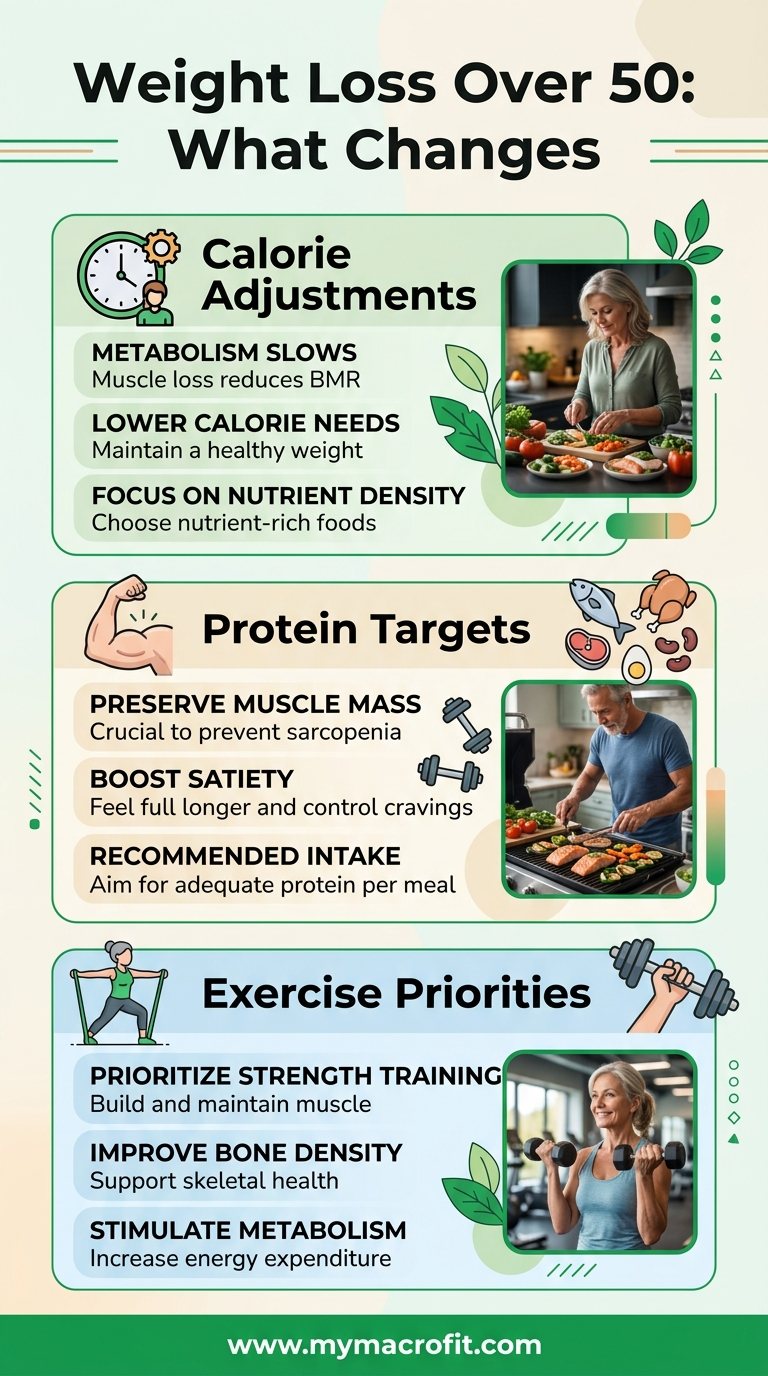
The combination of muscle loss, reduced activity, and hormonal changes means TDEE at 55 is typically 200-400 kcal lower than at 35 for the same person. Eating the same as you did at 35 is now a surplus.
Use our TDEE Calculator to calculate your current TDEE accurately, and select your actual current activity level honestly (it's often lower than we assume as we age).
What Still Works (The Fundamentals Don't Change)
Despite the above changes, the core fat loss mechanisms remain identical:
A calorie deficit is still required. This hasn't changed.
Protein still preserves muscle and maximises satiety. In fact, protein requirements may be slightly higher after 50, some research suggests older adults need 1.8-2.2g/kg to achieve the same muscle protein synthesis response as younger adults.
Sleep still matters enormously. Sleep deprivation is even more disruptive after 50 because the hormonal resilience buffer is reduced.
The Adjusted Strategy for Over 50
1. Reduce Daily Calorie Target Appropriately
With a lower TDEE, the same deficit that worked at 35 may now be too aggressive or may require a lower absolute calorie intake.
Practical target: Calculate TDEE at current weight and activity level, set deficit at 300-500 kcal/day. Don't try to do what worked at 30, the numbers are different now.
For women in perimenopause or post-menopause, our perimenopause nutrition guide covers the specific calorie and macro adjustments for this hormonal context.
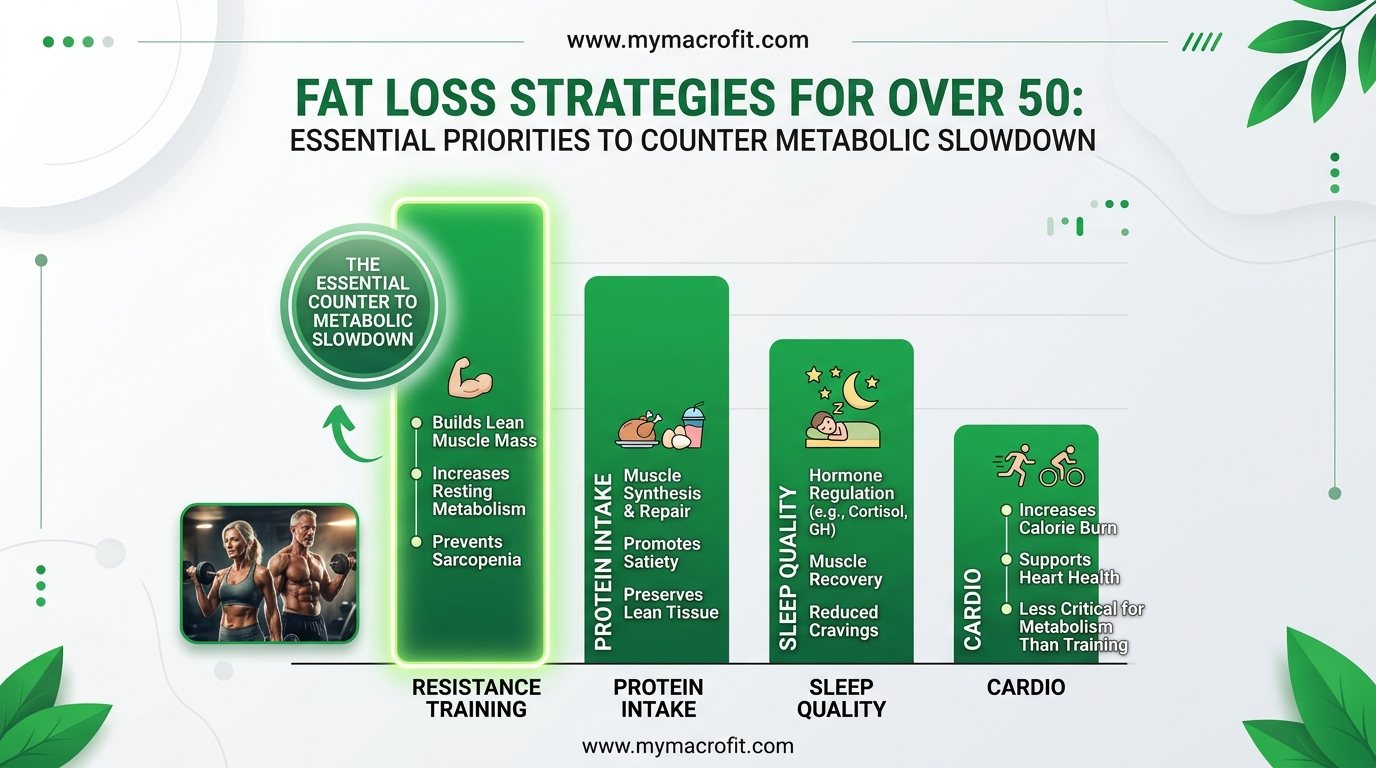
2. Prioritise Resistance Training Above Everything Else
If there's one non-negotiable change after 50, it's this: resistance training must be a priority, not an afterthought.
The muscle loss that drives metabolic slowing is largely preventable with consistent progressive resistance training. Multiple studies show older adults can build and maintain significant muscle mass well into their 70s and 80s with progressive loading.
Protocol: 3 full-body sessions per week with progressive overload (compound movements: squats, deadlifts, rows, presses). This directly counters sarcopenia and maintains the metabolic rate that supports fat loss.
Starting resistance training for the first time? See our beginner strength training guide.
3. Higher Protein: 2-2.2g/kg
After 50, the anabolic response to dietary protein becomes slightly blunted, older muscle requires slightly more protein stimulus to achieve the same synthesis response.
Target: 2-2.2g/kg bodyweight daily. Distribute across 3-4 meals of 35-50g each.
For a 70kg woman: 140-154g/day. For an 80kg man: 160-176g/day.
4. Prioritise Sleep and Stress Management
After 50, sleep disruption and cortisol elevation have more pronounced effects on fat storage (particularly visceral fat), insulin sensitivity, and muscle breakdown. Prioritising 7-9 hours of sleep and active stress management is not optional, it's a primary intervention.
See our sleep quality guide and cortisol and weight gain guide.
5. Keep Cardio Moderate, Not Excessive
Excessive high-intensity cardio in an older body increases cortisol significantly without proportional fat loss benefit. Moderate steady-state cardio (walking, cycling, swimming) is excellent for cardiovascular health and calorie expenditure without the cortisol cost.
Walking is particularly well-suited after 50, low impact, sustainable, scales easily. 8,000-10,000 steps daily is a highly effective tool.
6. Consider Creatine
Creatine supplementation has strong evidence in older adults specifically, not just for muscle building but for muscle preservation, cognitive function, and bone health. The muscle preservation benefit is particularly relevant for the sarcopenia concern.
Dose: 3-5g daily. No loading phase required.
Special Considerations for Women in Perimenopause/Menopause
The perimenopausal transition (typically 40s-early 50s) creates a particularly challenging weight management period:
Hormonal fluctuations make water retention variable, weight can fluctuate significantly week-to-week making progress harder to assess.
Visceral fat gain can occur even without a calorie surplus, the hormonal shift redistributes fat centrally. This is a reason to be more consistent with exercise and dietary quality, not a sign that "nothing works."
Sleep disruption from hot flushes and night sweats directly impairs fat loss through cortisol and hunger hormone effects.
For a complete guide to nutrition and fat loss during perimenopause and menopause, see our dedicated perimenopause and weight gain guide.
The Bottom Line
Weight loss after 50 is harder, but primarily because TDEE is lower, not because fat loss mechanisms have changed. A calorie deficit still works. The adjustments needed are: lower absolute calorie target, higher protein, resistance training as the primary exercise modality, and serious sleep prioritisation.
The biggest mistake people over 50 make is applying the same aggressive calorie restriction they used successfully at 30, which now impairs muscle mass, crashes hormones, and produces poorer body composition results.
Moderate deficit. High protein. Resistance training. Sleep. These four variables are more powerful after 50 than any programme or product.
Save & share on Pinterest
Click any card to pin it — or share with someone who needs it.
How to Lose Weight Over 50: What Changes and What Doesn't
Why weight loss becomes harder after 50, the hormonal, metabolic, and muscle changes involved, and t…
Why weight loss becomes harder after 50, the hormonal, metabolic, and muscle cha…
Read the full guide: How to Lose Weight Over 50: What Changes and What Doesn't
Try the free TDEE Calculator
How to Lose Weight Over 50: What Changes and What Doesn't — use our free calculators for instant per…
Pinterest opens in a new tab. You can edit the description before saving.
Ready to get your numbers?
Free calculator, instant results, no signup required.
Frequently Asked Questions
Why is it harder to lose weight after 50?+
How much weight can a woman over 50 realistically lose in a month?+
Is intermittent fasting good for weight loss after 50?+
About the Author

I'm a registered health coach and pre/postnatal specialist. I look at the whole person, your sleep, your stress, your hormones, because the number on the scale is only ever part of the story.
View full profile →