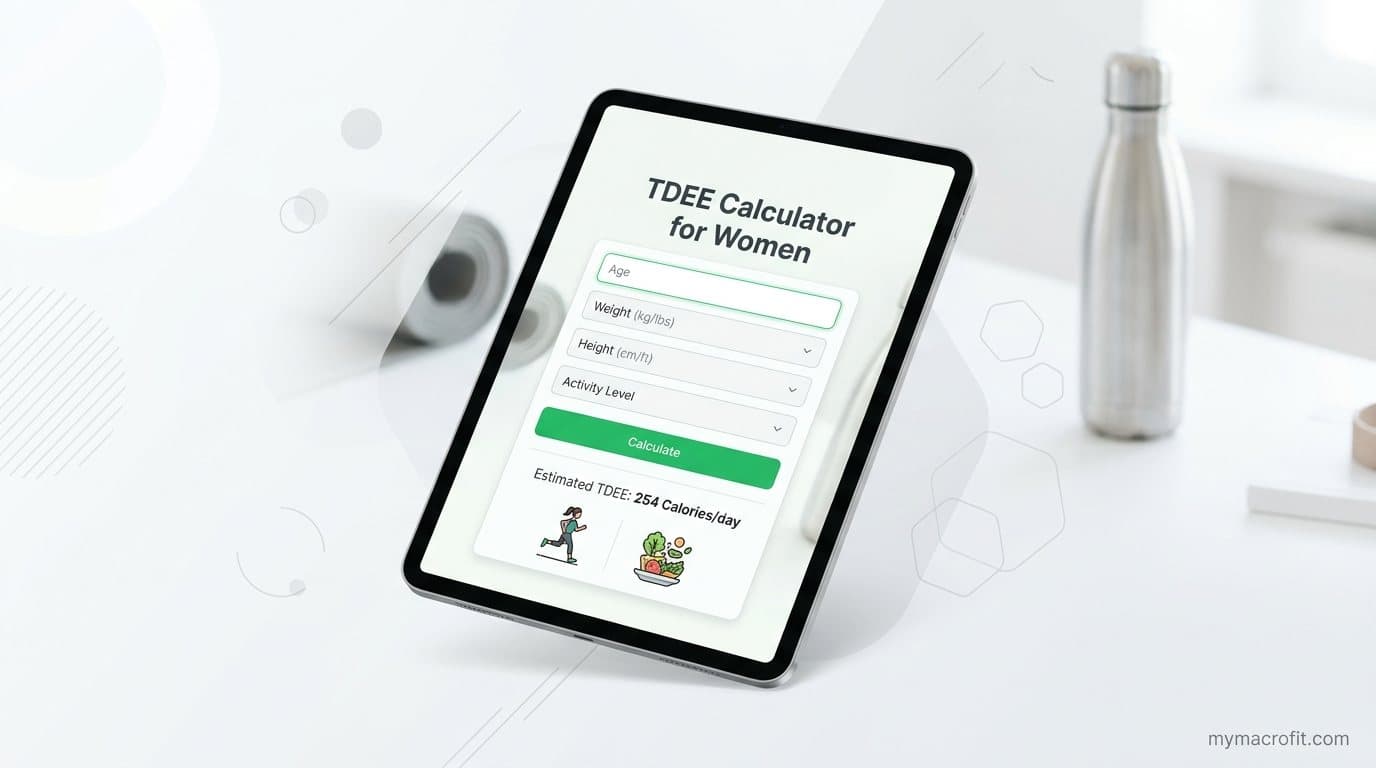
TDEE Calculator for Women: How Many Calories You Really Burn

RHC · Pre/Postnatal Fitness Specialist
If you've ever wondered "how many calories should I actually be eating?", the honest answer starts with one number: your TDEE, Total Daily Energy Expenditure, the calories your body burns in a day. Get this right and everything downstream (fat loss, maintenance, eating enough) becomes straightforward. Get it from a generic chart or a crash-diet number, and you're guessing. Here's how women can find their true maintenance and use it well.
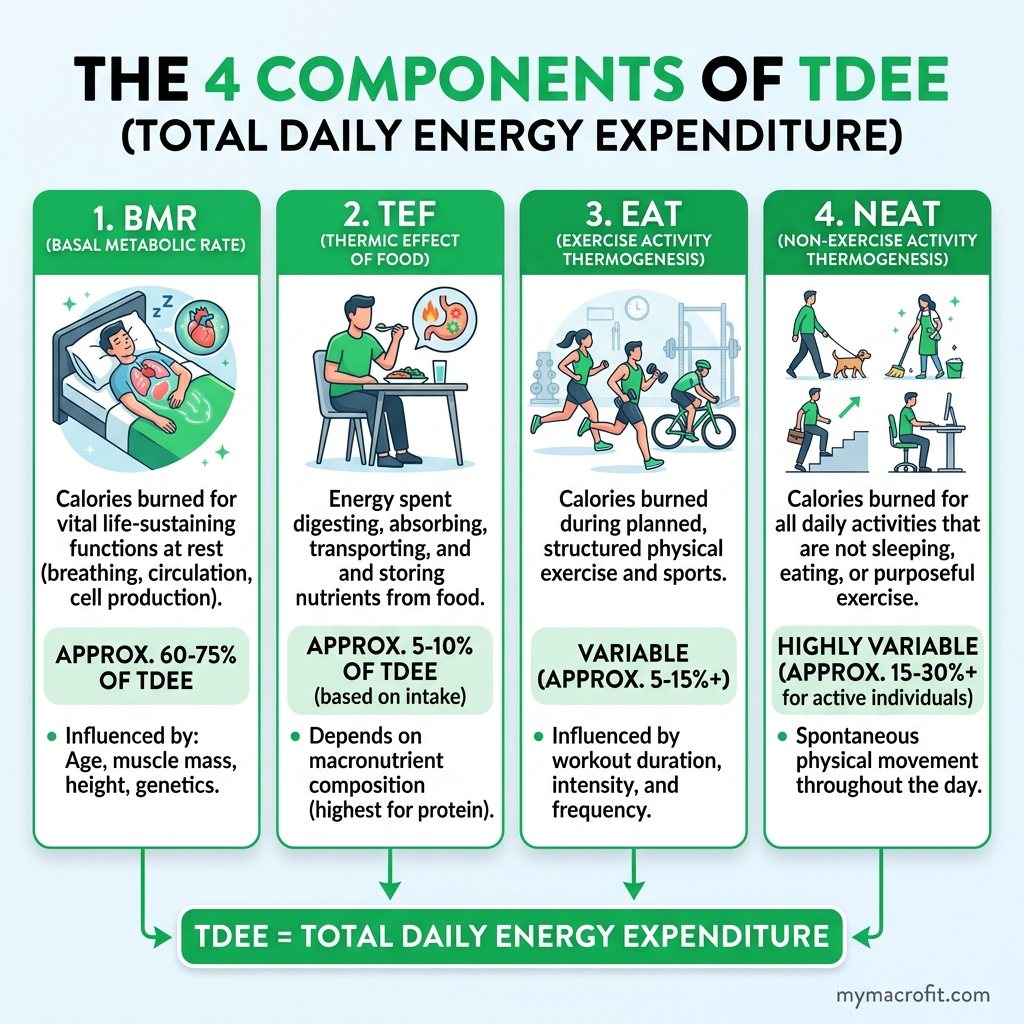
What TDEE is
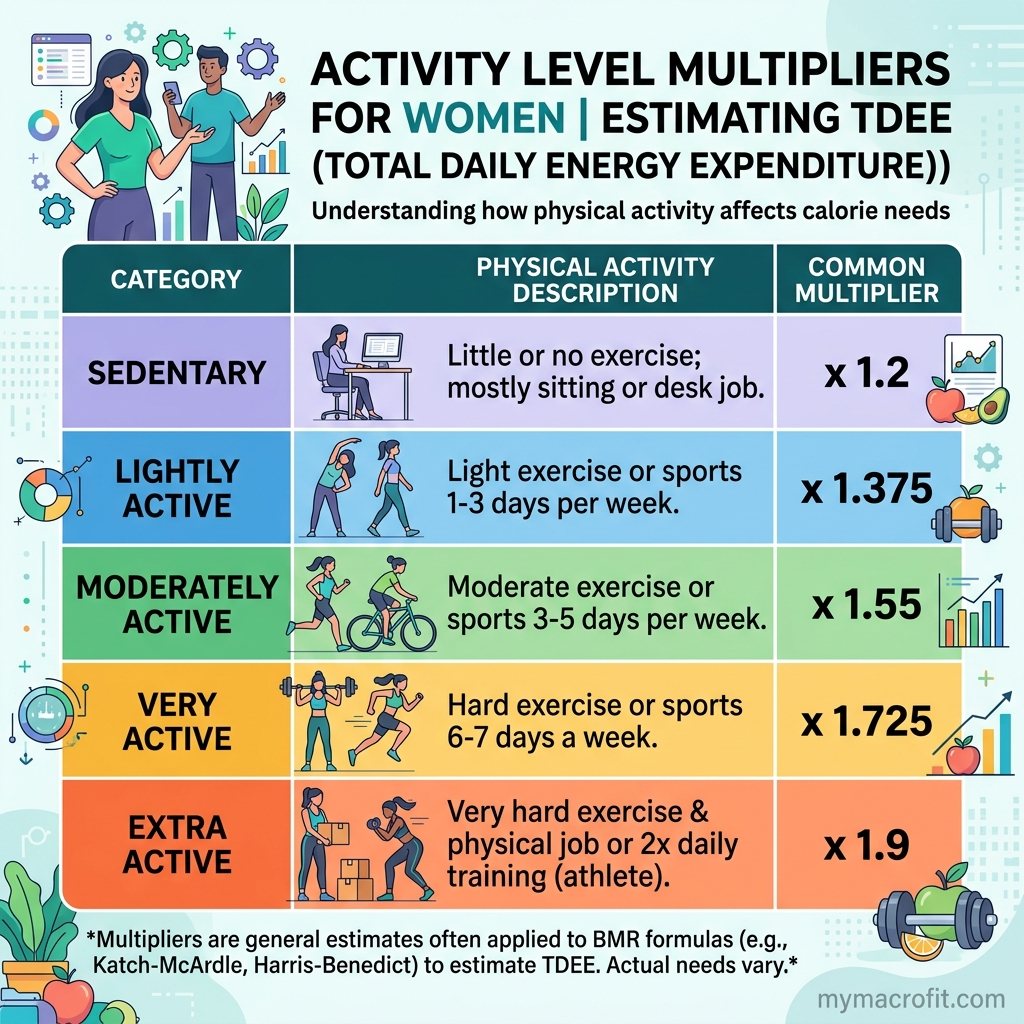
Your TDEE is your maintenance level, eat that many calories and your weight stays stable. It's built from your Basal Metabolic Rate (calories burned at rest) multiplied by an activity factor. To lose fat you eat below it; to gain you eat above it. Everything begins here.
The TDEE Calculator estimates yours from your age, height, weight, and activity using the Mifflin-St Jeor equation, the most accurate general formula for healthy adults.
Why the female formula differs
The equation uses a sex-specific term because, on average, women carry less muscle and have a smaller average body size, and muscle burns more calories at rest. That's why a woman's TDEE is typically lower than a similarly-aged man's. But it's an average, not your destiny, a strong, active, taller woman can have a higher maintenance than a smaller, sedentary man. The calculator personalises it to you, which is the whole point.
Find your real maintenance calories.
The free TDEE Calculator gives you a personalised number, the foundation for any goal.
Calculate My TDEE →Hormones, your cycle, and TDEE
Female physiology adds some nuance, but less than you'd fear:
- Across the menstrual cycle, energy burn rises slightly in the luteal phase (after ovulation), and appetite often climbs with it. The effect is small and averages out over the month, no need to change targets weekly. Track your menstrual cycle and training if you want to work with it.
- The fluctuations are mostly water, not fat. Judge progress by your weekly average weight, not day-to-day readings, which can swing a kilo or more around your period.
Menopause and the metabolic shift
Around perimenopause and menopause, falling oestrogen is linked to muscle loss and a redistribution of fat, which nudges maintenance calories down. The answer is not to keep slashing calories. It's to protect muscle with resistance training and higher protein, which defends your metabolic rate and body composition. Recalculate your TDEE as your weight and activity change, and see is perimenopause weight gain permanent for the full strategy. For a tailored figure, the Menopause Calorie Calculator accounts for this stage.
A worked example, and why the scale isn't the whole story
Take a 45-year-old woman, 165cm, 68kg, office job with two or three workouts a week. The calculator estimates her BMR near 1,380 and, at a lightly-to-moderately active level, a TDEE around 2,050.
From there her plan is gentle arithmetic:
- To hold steady: around 2,050 calories.
- For fat loss: a moderate 20% deficit puts her near 1,640, sustainable, and a world away from a punishing 1,200.
- Protein: prioritised at 1.8-2.0g/kg to protect muscle through this stage.
But here's what I'd want her to hold alongside the numbers: her body composition can be improving even when the scale is stubborn. As she protects muscle with protein and lifting, she may lose fat and gain a little muscle at once, so the scale barely moves while her clothes fit better, her energy steadies, and she feels stronger. The number on the scale is only part of the story, and in this decade it's often the least informative part.
Look at more than the scale
Because hormonal water shifts and slow recomposition can mask real progress, I encourage women to track a small handful of signals together rather than living and dying by one morning's weigh-in:
- Weekly average weight, not daily readings.
- How your clothes fit, often the truest mirror of fat loss.
- Energy, sleep, and mood, which tell you the plan is nourishing, not depleting, you.
- Strength in your workouts, a sign you're keeping the muscle that matters most now.
When most of those are trending the right way, the plan is working, even on a week the scale sulks. That fuller picture is what keeps women going through a stage where the scale alone can be quietly discouraging.
How to use your number
- Maintenance: eat around your TDEE to hold steady.
- Fat loss: subtract a moderate deficit (15-25%), for most women this lands well above the dreaded 1,200. Use the Calorie Deficit Calculator.
- Set macros: split your target with protein high using the Macro Calculator.
- Recalculate every 4-5kg of weight change, since a lighter body burns less.

The takeaway
Your TDEE is the single most useful number in your nutrition, and as a woman it's worth calculating properly rather than defaulting to a generic low-calorie target. Find your real maintenance with the TDEE Calculator, subtract a sensible deficit, protect your muscle with protein and lifting, and let your weekly trend, not the daily scale, tell you the truth.
Save & share on Pinterest
Click any card to pin it — or share with someone who needs it.
TDEE Calculator for Women: How Many Calories You Really Burn
How to find your true maintenance calories as a woman, why the standard formula works, where it goes…
How to find your true maintenance calories as a woman, why the standard formula …
Read the full guide: TDEE Calculator for Women: How Many Calories You Really Burn
Try the free TDEE Calculator
TDEE Calculator for Women: How Many Calories You Really Burn — use our free calculators for instant …
Pinterest opens in a new tab. You can edit the description before saving.
Ready to get your numbers?
Free calculator, instant results, no signup required.
Frequently Asked Questions
How many calories does the average woman burn per day?+
Why is women's TDEE lower than men's?+
Do hormones and the menstrual cycle change my TDEE?+
Does menopause lower your calorie needs?+
Is 1,200 calories the right target for women?+
Why does my weight jump up around my period if I'm in a deficit?+
Should I eat back the calories my fitness watch says I burned?+
About the Author

I'm a registered health coach and pre/postnatal specialist. I look at the whole person, your sleep, your stress, your hormones, because the number on the scale is only ever part of the story.
View full profile →