A No-Equipment Leg Workout You Can Do in Your Living Room
Kinesiotherapist · Pilates Coach
People assume legs are the one body part that truly needs a gym. They are wrong. The lower body is built for bodyweight work, especially once you start training one leg at a time. I have given people leg sessions that left them properly sore using nothing but their living room floor. Your body is your only investment, and your legs are more than happy to be paid in single-leg squats.
Why single-leg work is the secret
Two-leg squats are a fine starting point, but they get easy quickly, and you cannot add a barbell at home. The answer is simple: train one leg at a time. A split squat or a step-up loads the working leg with roughly your whole bodyweight, which is plenty of challenge. This is how bodyweight leg training stays effective long after the beginner stage.
The workout
Move through these with control. Aim for two or three rounds, taking each set close to the point where your form would slip.
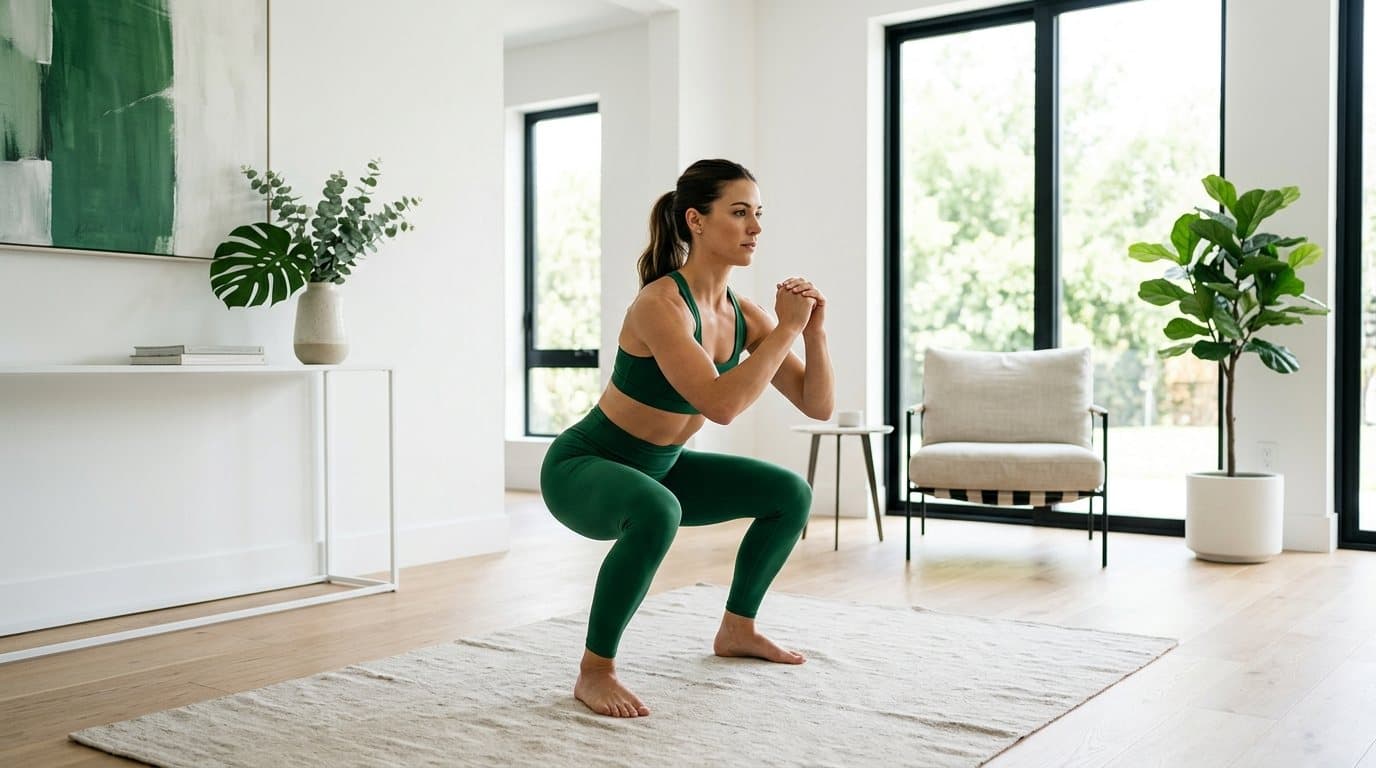
1. Bodyweight squats (warm-up and base)
Feet about shoulder-width, send your hips back and down like sitting into a chair, chest tall, knees tracking over your toes. Go as deep as you can with control, then push the floor away to stand. Do these first to warm the joints and groove the pattern.
2. Split squats (the main event)
Step one foot forward and one back. Lower straight down, letting your back knee travel toward the floor, keeping your front shin fairly upright and your torso tall. Press through your front foot to rise. Do all your reps on one leg, then swap. This is where the real strength is built. To make it harder, slow the descent or elevate your back foot on a low surface.
3. Step-ups
Use a sturdy chair or step. Place one foot fully on it, drive through that heel to stand all the way up, then lower with control. Keep the working leg doing the work rather than pushing off the floor with the bottom foot. Step-ups build strength and balance together.
4. Single-leg glute bridges
Lie on your back, one knee bent with that foot flat, the other leg extended. Drive through the planted heel to lift your hips, squeezing the glute hard at the top, then lower slowly. This trains the back of the leg and the glutes, which sitting all day tends to switch off.
5. Calf raises
Stand tall, rise onto the balls of your feet, pause at the top, and lower slowly. Do them on the edge of a step for a fuller range. Slow and controlled beats fast and bouncy.
The session at a glance
So you can picture the whole thing before you start, here is how the workout fits together. Move through it as a circuit of two or three rounds, resting as needed.
| Exercise | Trains | Reps |
|---|---|---|
| Bodyweight squats | Warm-up, quads, glutes | 12-15 |
| Split squats | Quads, glutes (single leg) | 8-12 each leg |
| Step-ups | Quads, glutes, balance | 8-12 each leg |
| Single-leg glute bridges | Glutes, hamstrings | 10-15 each leg |
| Calf raises | Calves | 15-20 |
Notice how it covers a squat, single-leg work, a hinge for the back of the legs, and the calves, the whole lower body in five moves. You do not need more than this. You need to do these well, with control, and progress them over the weeks.
Keep it challenging
When the workout starts to feel manageable, do not just add endless reps. Make it harder:
- Slow every lowering phase to three or four seconds.
- Pause for a breath at the bottom of each rep.
- Progress to harder single-leg variations.
- Increase your depth and range of motion.
This is the same principle behind all bodyweight strength training: challenge the muscle a little more over time.
Recover and refuel
Legs are big muscles, so train them two or three times a week with a recovery day between hard sessions. The strength is built while you rest, not during the workout, which is why rest days matter. And remember that muscle needs material to grow, so get enough protein. Train your legs with control, progress patiently, and they will get strong without a single weight in sight.
Save & share on Pinterest
Click any card to pin it — or share with someone who needs it.
A No-Equipment Leg Workout You Can Do in Your Living Room
Strong legs need no gym and no weights. Here is a complete bodyweight leg workout, the right form fo…
Strong legs need no gym and no weights. Here is a complete bodyweight leg workou…
Read the full guide: A No-Equipment Leg Workout You Can Do in Your Living Room
Free fitness tools
A No-Equipment Leg Workout You Can Do in Your Living Room — use our free calculators for instant per…
Pinterest opens in a new tab. You can edit the description before saving.
Frequently Asked Questions
Can you build leg muscle without weights?+
How do I make bodyweight leg exercises harder?+
Are bodyweight squats enough for legs?+
How often should I train legs at home?+
How many reps should I do for bodyweight legs?+
My knees hurt during squats and lunges, what can I do?+
Can I lose weight with a bodyweight leg workout?+
About the Author
I'm a kinesiotherapist and Pilates coach. I help people move well and get strong without breaking down, from fixing a stiff back to building real strength using nothing but their own bodyweight.
View full profile →