The Best Bodyweight Exercises for a Full-Body Workout at Home
Kinesiotherapist · Pilates Coach
You do not need a rack of equipment to train your whole body. You need a handful of movements, done with control and made gradually harder over time. I have built entire programmes for people using nothing but the floor and their own bodyweight, and they got genuinely strong. Your body is your only investment, and these are the movements that get the most out of it.
Cover the patterns, not the muscles
The mistake people make is chasing dozens of exercises. You do not need them. Your body moves in a few basic patterns, and if you train each one, you have trained everything that matters. Choose one movement from each of these and you have a complete workout.
Push: the push-up
The push-up is the king of upper-body bodyweight work. It builds the chest, shoulders, and triceps, and it doubles as a moving plank for your core.
Set your hands a little wider than your shoulders. Keep your body in one straight line from head to heels, ribs gently down so you do not sag through the lower back. Lower with control until your chest is just above the floor, then press up. If a full push-up is too much, start with your hands on a raised surface or your knees down. The full path is in push-up progression.
Squat: the bodyweight squat and split squat
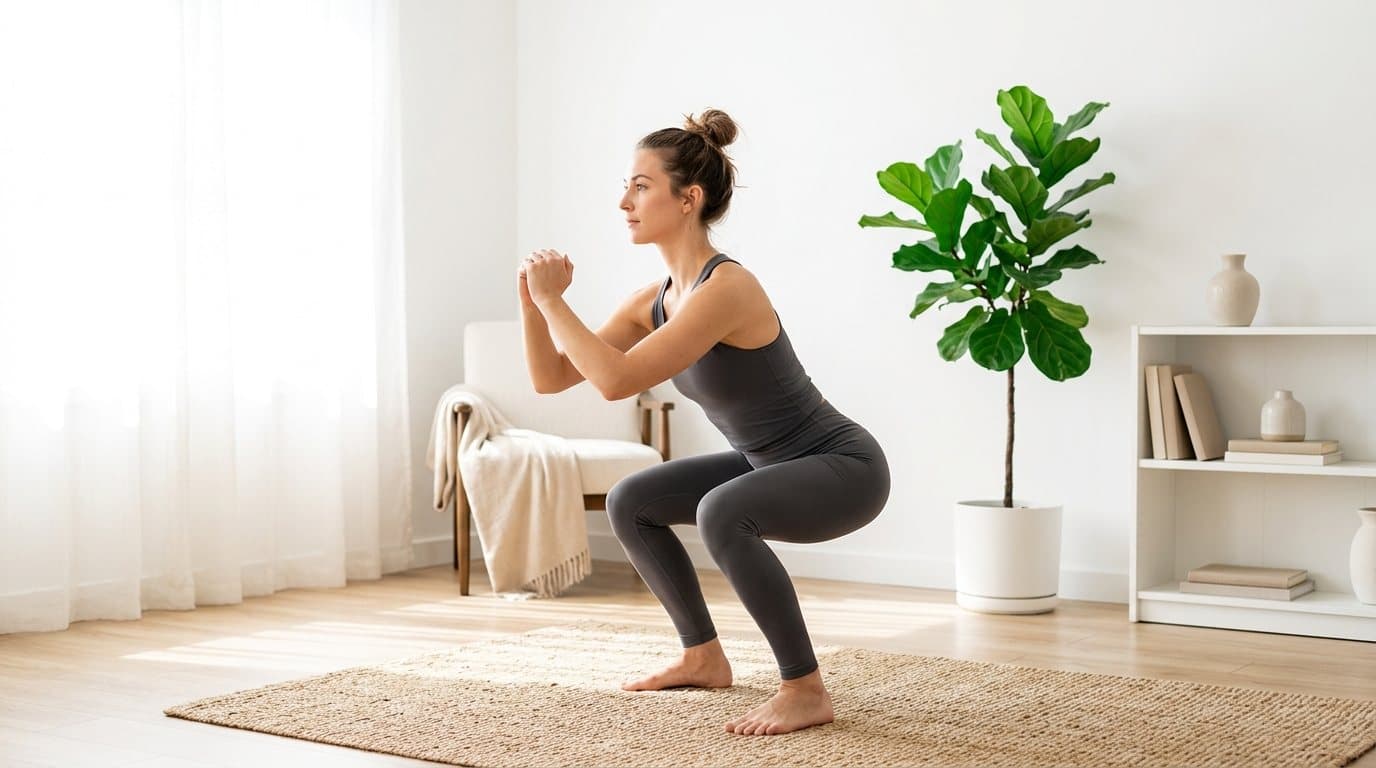
Squats build your legs and glutes and keep your hips healthy. Stand about shoulder-width, send your hips back and down as if sitting into a chair, keep your chest tall, and go as deep as you can with control. Push the floor away to stand.
When two-leg squats become easy, progress to split squats, one leg forward, one back, lowering the back knee toward the floor. The single-leg challenge is far greater. There is a full session in the no-equipment leg workout.
Hinge: the glute bridge
The hinge trains the back of your body, the glutes and hamstrings, which long hours of sitting tend to switch off. Lie on your back, knees bent, feet flat. Drive through your heels and lift your hips until your body forms a line from knees to shoulders. Squeeze your glutes at the top, lower slowly. Progress to a single-leg version when ready.
Pull: the bodyweight row
Pulling is the pattern people skip because it seems to need equipment. It does not have to. Lie under a sturdy table, grip the edge, and pull your chest toward it, keeping your body straight. A strong towel looped around a solid post or door works too. Pulling balances all that pushing and is vital for shoulder health and posture.
Core: the plank and dead bug
Your core's real job is to keep you stable, so train it that way. Hold a plank with your body in a straight line, ribs down, glutes gently squeezed, breathing steadily. For the dead bug, lie on your back and slowly lower opposite arm and leg while keeping your lower back pressed gently into the floor. These build the deep stability that protects your spine, which I cover fully in core stability and Pilates.
Put it together
A simple, complete session:
- Push-ups (or your variation)
- Squats or split squats
- Glute bridges
- Rows
- Plank and dead bugs
Do two or three rounds, taking each hard set close to fatigue, resting a minute or two between rounds. Three or four sessions a week, with rest between hard days, builds real strength.
The five patterns at a glance
So the whole approach sits in one view, here are the patterns, what each trains, and a beginner-friendly starting point. Choose one from each row and you have trained your whole body.
| Pattern | Trains | Start with |
|---|---|---|
| Push | Chest, shoulders, triceps | Incline or knee push-up |
| Squat | Quads, glutes | Bodyweight squat |
| Hinge | Glutes, hamstrings | Glute bridge |
| Pull | Back, biceps, posture | Table or towel row |
| Core | Deep stability | Plank, dead bug |
The beauty of training patterns rather than chasing individual muscles is that nothing gets missed and nothing is wasted. Five movements, covered well, leave no major muscle untrained, which is why you genuinely do not need a long list of exercises.
Why pulling is the one not to skip
Of the five, pulling is the pattern people quietly drop, because it feels like the one that needs equipment. Please do not. All that pressing and forward-sitting from daily life leaves the front of the body tight and the upper back weak, and rows are the antidote. They balance your pushing, build the upper back that holds your shoulders in a healthier position, and directly help the posture and shoulder comfort so many people struggle with. A row under a sturdy table or with a towel around a solid post costs nothing and protects a great deal. If you only add one thing to a push-heavy home routine, make it pulling.
Move well, then add challenge
Quality first. A controlled, full-range push-up beats ten rushed ones every time. Once a movement feels easy, make it harder rather than just doing more reps. That is the whole method, and it is laid out in the bodyweight strength training guide. Master these patterns, respect your form, and your body will get strong without a single weight.
Save & share on Pinterest
Click any card to pin it — or share with someone who needs it.
The Best Bodyweight Exercises for a Full-Body Workout at Home
You only need a handful of movements to train your whole body with no equipment. Here are the best b…
You only need a handful of movements to train your whole body with no equipment.…
Read the full guide: The Best Bodyweight Exercises for a Full-Body Workout at Home
Free fitness tools
The Best Bodyweight Exercises for a Full-Body Workout at Home — use our free calculators for instant…
Pinterest opens in a new tab. You can edit the description before saving.
Frequently Asked Questions
What are the best bodyweight exercises?+
Can you get a full body workout with no equipment?+
How many reps should I do for bodyweight exercises?+
How do I make bodyweight exercises harder over time?+
How many days a week should I do a full-body bodyweight workout?+
Do I need a warm-up before bodyweight training?+
Is bodyweight training enough to build noticeable muscle?+
About the Author
I'm a kinesiotherapist and Pilates coach. I help people move well and get strong without breaking down, from fixing a stiff back to building real strength using nothing but their own bodyweight.
View full profile →