The Complete Muscle Building Guide: Training, Nutrition, and Recovery

BSc Kinesiology · CPT
I'll give you the honest version most fitness content won't: building muscle is slow. Slower than the transformation photos suggest, and far more systematic than the average gym-goer approaches it. But here's the good news that my background in exercise science has reinforced again and again, it is also predictable. The mechanisms of hypertrophy are well understood, the research is remarkably consistent, and when you apply the principles correctly, results follow on a timeline you can actually plan around. Muscle growth is not luck. It's signal, fuel, and recovery, repeated.
This guide covers the whole system: how muscle growth actually works at the cellular level, how to train to trigger it, how to eat to support it, and how to recover so it happens at all.
How Muscle Growth Works
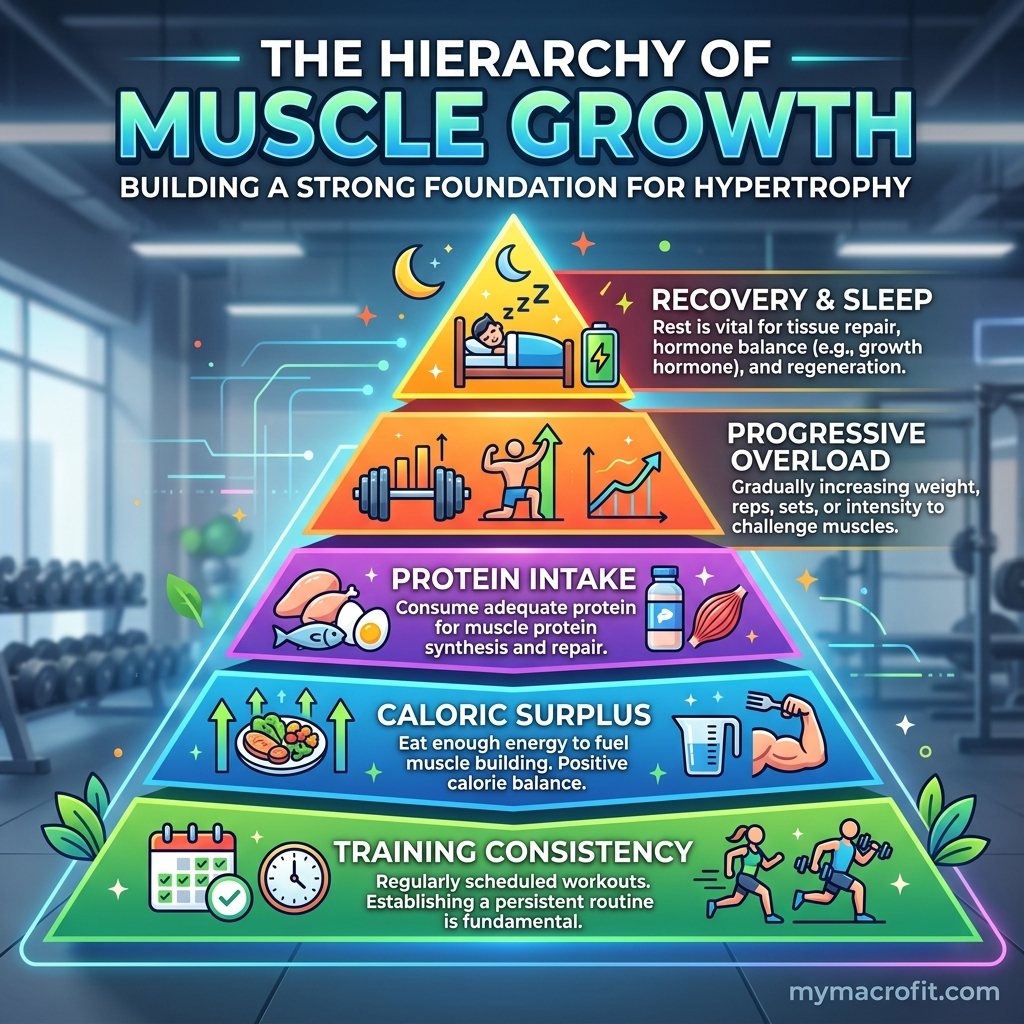
Muscle hypertrophy (growth) occurs through a two-step process:
- Mechanical tension + metabolic stress, resistance training damages muscle fibres, creating a stimulus for adaptation
- Muscle protein synthesis (MPS), the body repairs and builds new muscle protein in response to the stimulus, with dietary protein as the raw material
For muscle to grow, MPS must exceed muscle protein breakdown (MPB). Two variables drive this:
- Training stimulus (progressive overload)
- Dietary protein (adequate amino acids for synthesis)
Both are non-negotiable. Training without protein produces adaptation but no new mass. Protein without training produces nothing useful.
The Training Principles That Drive Growth
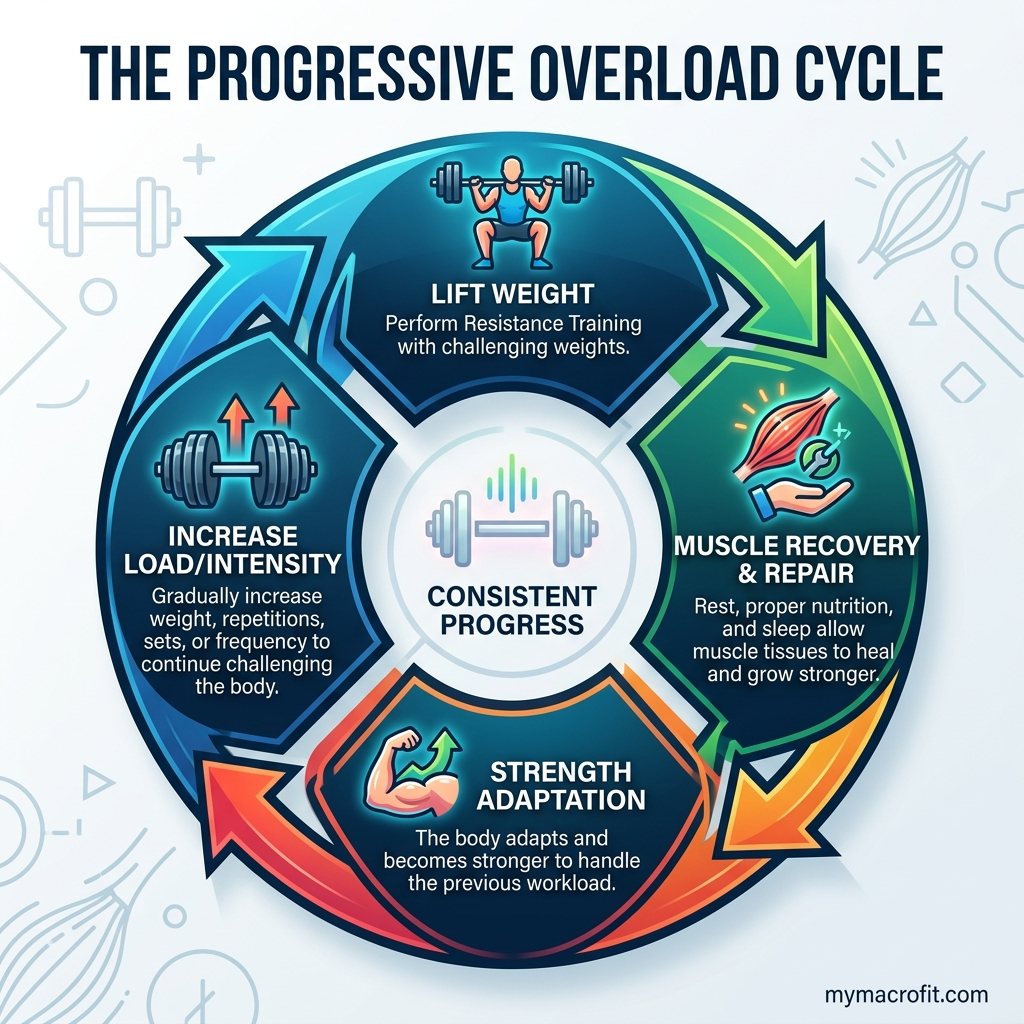
Progressive Overload
The most important principle in all of strength training. If you do not progressively increase the demands placed on your muscle over time, your body has no reason to adapt by growing.
Progressive overload means consistently increasing one or more of:
- Load, lifting heavier weight
- Reps, more repetitions at the same weight
- Volume, more sets per session or week
- Frequency, more sessions per muscle group per week
Without progression, you maintain what you have. With progression, you build.
Practical approach: Aim to add weight (small increments) or an extra rep to a working set every 1-2 weeks on key compound lifts.
Training Volume
Research suggests 10-20 sets per muscle group per week is the effective range for hypertrophy in most people. Beginners respond to lower end; advanced trainees need higher volume.
Effective weekly sets by muscle group:
| Experience | Sets per muscle group/week |
|---|---|
| Beginner | 8-12 sets |
| Intermediate | 12-18 sets |
| Advanced | 16-22 sets |
Rep Range
Muscle can be built across a wide rep range (5-30 reps). Studies show that sets taken close to failure produce similar hypertrophy whether performed at 5 reps or 30 reps. The practical implication:
- Heavy compound work (5-8 reps): Builds strength and mass efficiently
- Moderate range (8-15 reps): Classic hypertrophy range, good balance of load and volume
- Higher reps (15-25 reps): Effective for isolation exercises and finishing sets
Use a mix. Don't be dogmatic about a single rep range.
Compound Movements First
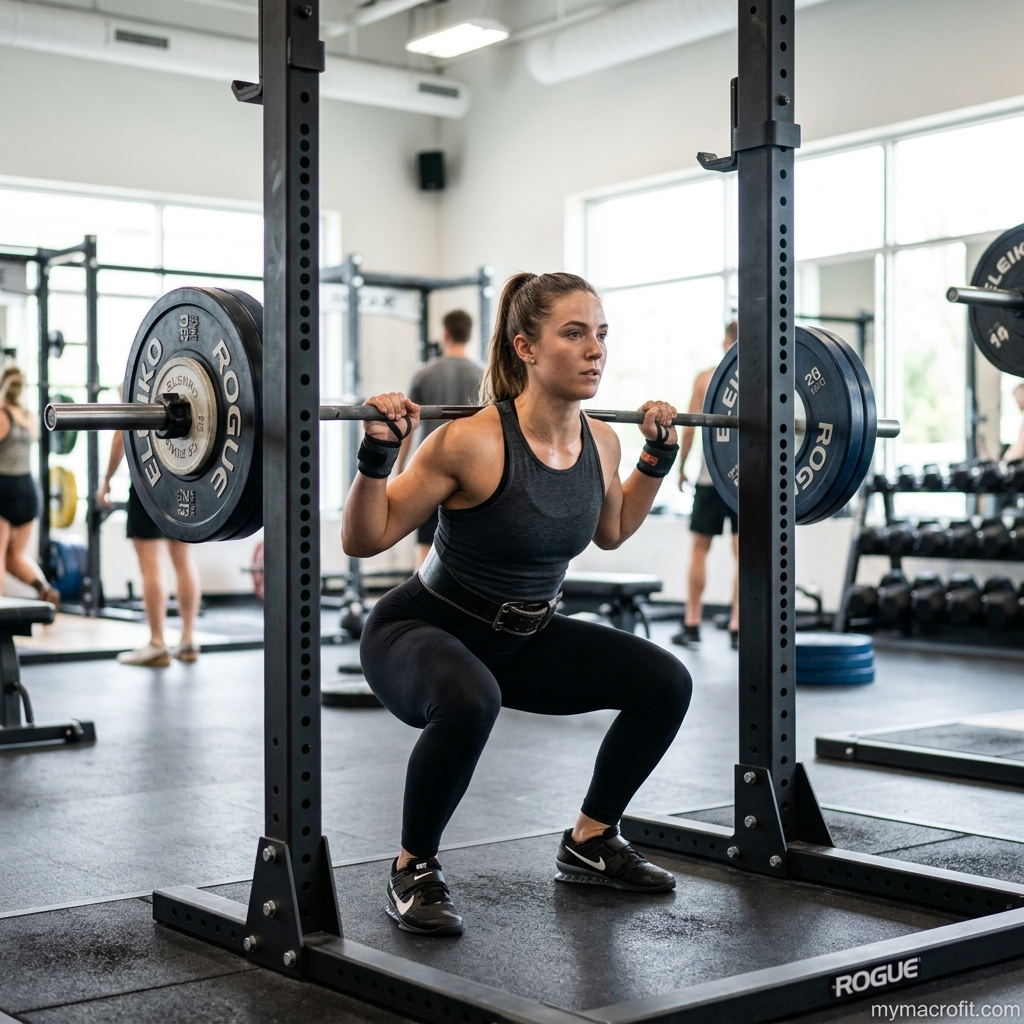
Compound movements recruit the most muscle mass and produce the greatest anabolic hormone response. Build your programme around:
- Squat (quads, glutes, hamstrings)
- Hip hinge, deadlift, Romanian deadlift (posterior chain)
- Horizontal push, bench press, push-up (chest, triceps, front delts)
- Horizontal pull, row (back, biceps, rear delts)
- Vertical push, overhead press (shoulders, triceps)
- Vertical pull, pull-up, lat pulldown (lats, biceps)
Add isolation exercises after compounds for lagging muscle groups.
Nutrition for Muscle Building
Calorie Surplus
To build muscle optimally, you need a calorie surplus, eating above TDEE provides energy for protein synthesis and training performance.
Optimal surplus by goal:
| Approach | Daily surplus | Monthly lean gain estimate |
|---|---|---|
| Lean bulk (minimise fat) | +200-300 kcal | 0.5-1kg lean mass |
| Standard bulk | +300-500 kcal | 1-2kg total (lean + fat) |
| Aggressive bulk | +500+ kcal | 2-4kg total (significant fat gain) |
The lean bulk approach takes longer but requires less subsequent cutting. Most people optimise at a modest 200-350 kcal surplus.
→ Read more: Lean Bulking: How to Build Muscle Without the Fat
Protein
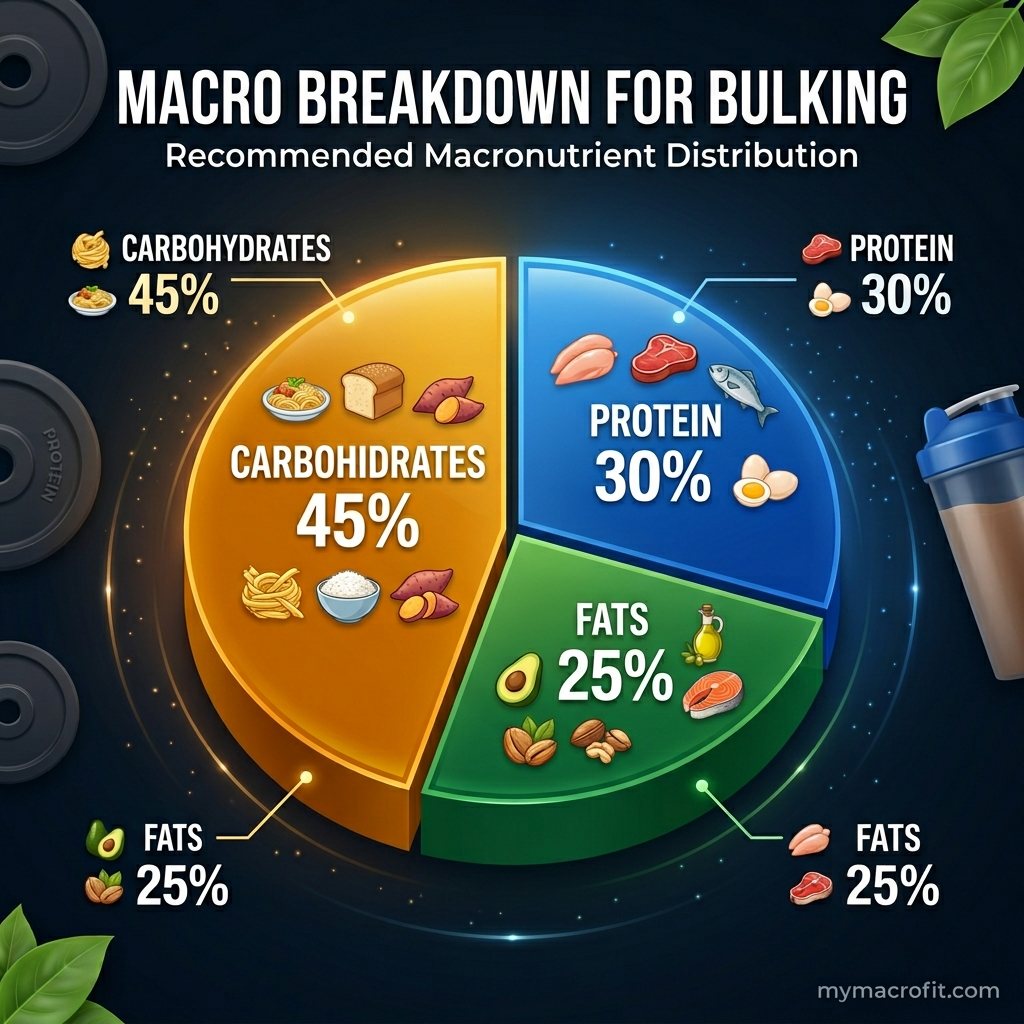
Set protein first at 1.6-2.2g per kg of bodyweight. Spreading this across 4-5 meals of 30-50g each optimises MPS throughout the day.
For a 75kg person: 120-165g protein/day
→ See: 50 High Protein Foods Ranked | How Much Protein Do I Need?
Carbohydrates
Carbohydrates are the primary fuel for resistance training. Glycogen (stored carbohydrate in muscle) powers the high-intensity work that drives progressive overload. Training on depleted glycogen:
- Reduces strength and power output
- Impairs training volume
- Reduces the training stimulus → less growth signal
Target: 3-5g/kg bodyweight for active training phases. Prioritise complex carbs (rice, oats, sweet potato, pasta) with some fast carbs post-training.
Fat
Fat supports testosterone production (critical for muscle building) and fat-soluble vitamin absorption. Keep fat at a minimum of 0.8-1g/kg.
Supplement Note
Creatine monohydrate, the most evidence-backed supplement for muscle building. 3-5g/day increases phosphocreatine stores, allowing more volume and intensity in training. The effect on lean mass over 12 weeks is well-documented.
Recovery: Where Muscle Is Actually Built
Muscle is not built during training, it's built during recovery. Training provides the stimulus; sleep and nutrition provide the building materials and time.
Sleep
7-9 hours per night is non-negotiable for muscle building. The majority of growth hormone (which directly stimulates muscle protein synthesis) is released during slow-wave deep sleep. Studies show that sleep-deprived subjects retain significantly less muscle on identical training programmes.
→ Read more: Sleep and Weight Loss (and Muscle Building)
Rest Days
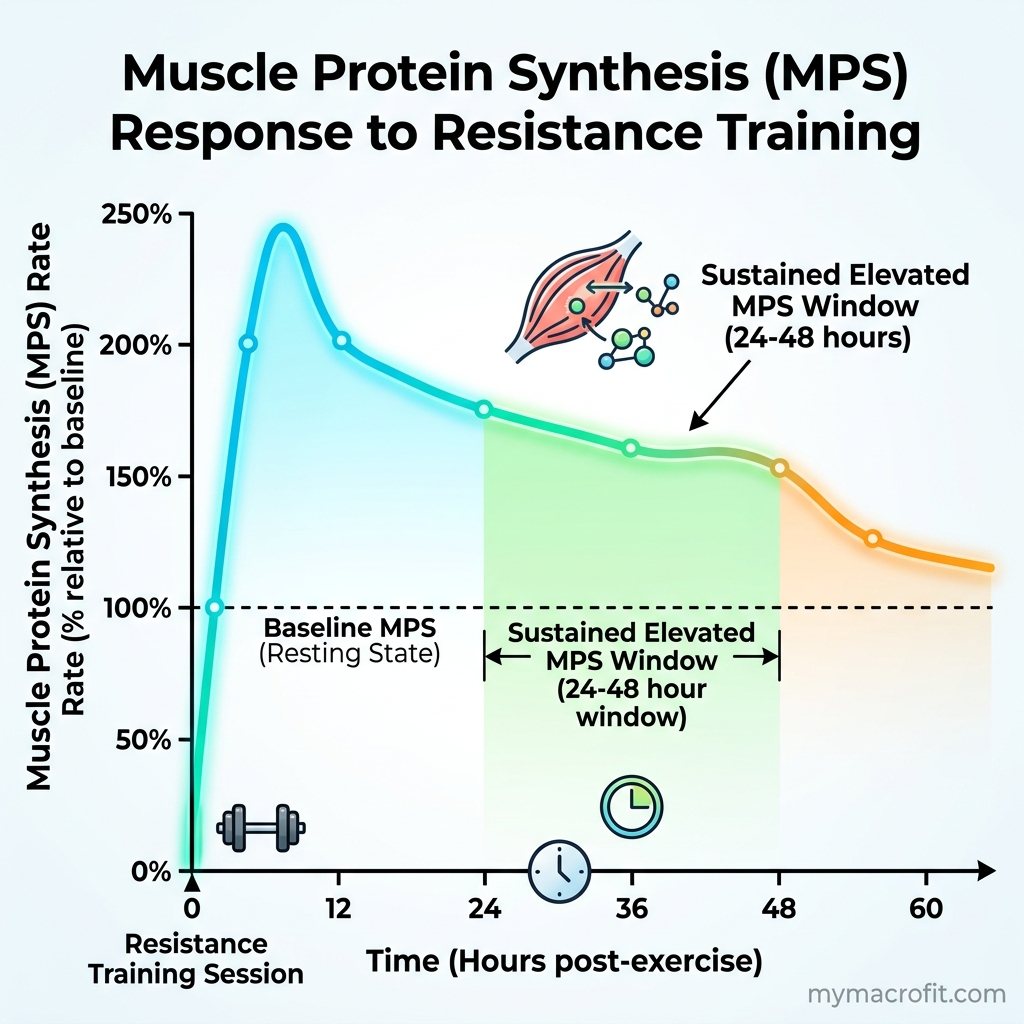
Muscle groups need 48-72 hours between intense sessions to fully recover and undergo protein synthesis. A full-body 3x/week programme naturally provides this. A 4-5 day upper/lower or push-pull-legs split also achieves it with proper programming.
Signs you're under-recovered:
- Persistent soreness beyond 72 hours
- Strength declining session to session
- Mood deterioration, elevated resting heart rate
- Poor sleep quality
Sample Training Programmes
Beginner, 3-Day Full Body
Each session, 3 sets × 8-12 reps on:
- Squat variation (goblet squat → barbell back squat)
- Hip hinge (Romanian deadlift → deadlift)
- Horizontal push (push-up → bench press)
- Horizontal pull (dumbbell row)
- Vertical push (dumbbell overhead press)
- Vertical pull (lat pulldown → assisted/full pull-up)
Frequency: 3× per week, non-consecutive days (Mon/Wed/Fri)
Intermediate, 4-Day Upper/Lower Split
Upper A: Bench press, row, overhead press, pulldown, bicep curl, tricep dip Lower A: Squat, Romanian deadlift, leg press, lunges, calf raise Upper B: Incline press, cable row, lateral raise, pull-up, hammer curl, skull crusher Lower B: Deadlift, hip thrust, leg extension, leg curl, core work
Frequency: Mon/Tue/Thu/Fri with Wed and weekend recovery
Realistic Progress Expectations
| Experience | Monthly lean gain (optimal conditions) |
|---|---|
| Beginner (0-1 year) | 0.5-1.2kg |
| Intermediate (1-3 years) | 0.25-0.6kg |
| Advanced (3+ years) | 0.1-0.25kg |
These rates assume: calorie surplus, high protein, consistent progressive overload training, adequate sleep, low stress. Actual results vary, but anyone claiming faster rates is either a genetic outlier or using performance-enhancing drugs.
All Articles in This Guide
- Lean Bulking: How to Build Muscle Without the Fat
- How Much Protein Do I Need to Build Muscle?
- Build Muscle as a Woman
- Strength Training for Weight Loss
- 50 High Protein Foods Ranked
Sources
- ISSN Position Stand: protein and exercise, Stokes et al., JISSN, 2018
- Mechanisms of hypertrophy: a review, Schoenfeld, Journal of Strength & Conditioning Research, 2010
- Weekly volume recommendations for hypertrophy, Schoenfeld et al., JISSN, 2017
- Creatine supplementation and lean body mass, Lemon et al., JISSN, 2003
Save & share on Pinterest
Click any card to pin it — or share with someone who needs it.
The Complete Muscle Building Guide: Training, Nutrition, and Recovery
Everything you need to build muscle, how muscle growth works, protein targets, calorie surplus, trai…
Everything you need to build muscle, how muscle growth works, protein targets, c…
Read the full guide: The Complete Muscle Building Guide: Training, Nutrition, and Recovery
Free fitness tools
The Complete Muscle Building Guide: Training, Nutrition, and Recovery — use our free calculators for…
Pinterest opens in a new tab. You can edit the description before saving.
Frequently Asked Questions
How long does it take to build noticeable muscle?+
Do I need a calorie surplus to build muscle?+
How much protein do I need to build muscle?+
Is cardio bad for muscle building?+
About the Author

I'm a kinesiologist and personal trainer. I've spent eight years helping women lose fat and get stronger without handing their whole life over to a diet.
View full profile →