The Complete Weight Loss Guide: Evidence-Based Fat Loss from Start to Finish
Founder, MyMacroFit
This is the guide I wish someone had handed me when I started. I lost 25kg myself, the slow and unglamorous way, and along the road I read a ridiculous amount and made most of the mistakes so you do not have to. I am not a coach, but I have collected everything that actually worked into one place. No fad diets, no extreme restriction, no nonsense that wastes months you cannot get back. Just how fat loss really works and how to build something that survives a busy week.
It is long, because doing this properly is worth understanding properly. Start here, follow the links into the detail you need, and come back whenever you get stuck.
How Fat Loss Actually Works
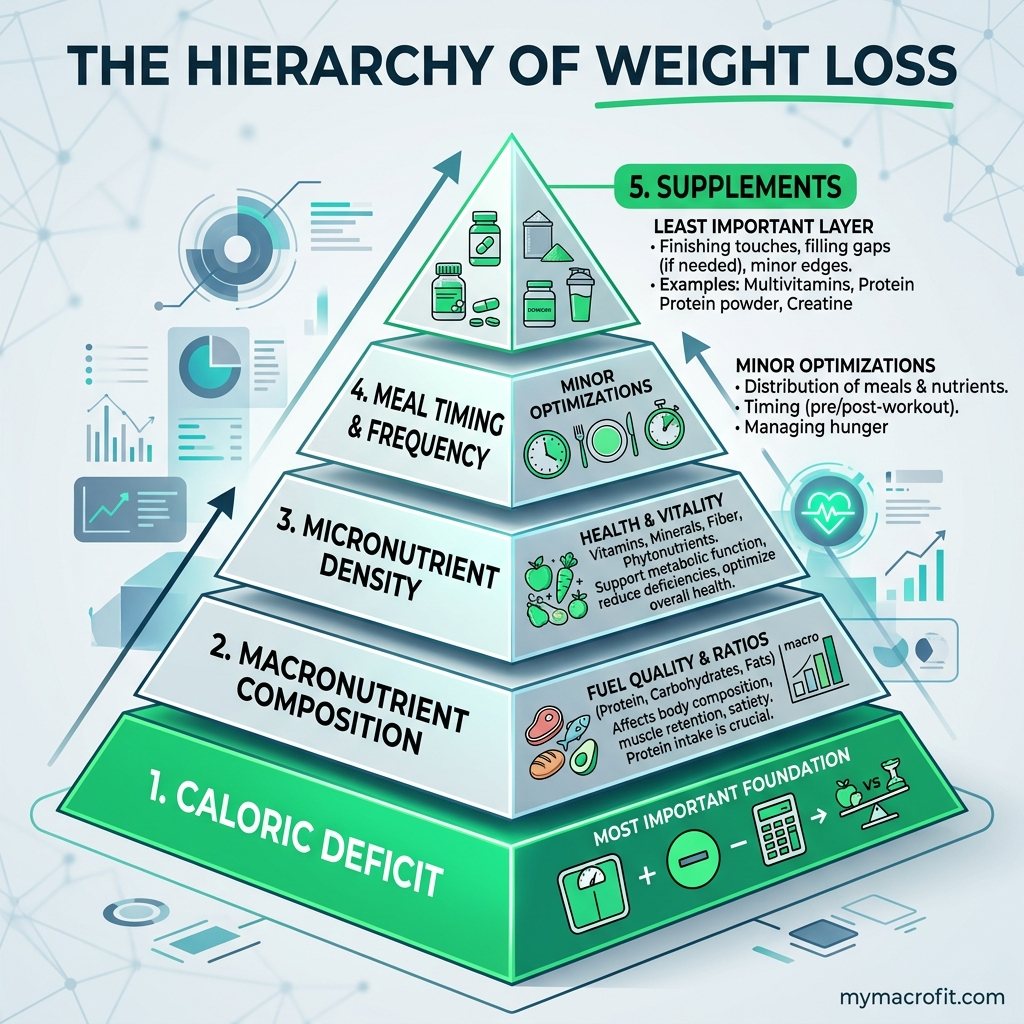
Fat loss has exactly one non-negotiable: a calorie deficit. You have to eat fewer calories than your body burns. This took me years to truly accept, because I wanted it to be about the right diet or the magic workout. Everything else, the diet you pick, the training, the meal timing, only changes how comfortable and sustainable that deficit is, and how much muscle you keep. Nothing replaces the deficit itself.
Fat tissue is stored energy. One kilogram of body fat contains approximately 7,700 kcal of stored energy. To lose 1kg of fat, you need a cumulative deficit of 7,700 kcal, roughly a 500 kcal/day deficit maintained for 15-16 days.
This is why:
- You cannot out-exercise a bad diet (exercise burns 200-400 kcal; a biscuit is 150 kcal)
- "Detox" products and cleanses do not cause fat loss (they affect water and waste)
- Rapid weight loss (>1kg/week) loses muscle alongside fat, not just fat
→ Read more: How Many Calories Does It Take to Lose 1kg?
Step 1: Calculate Your Calorie Target
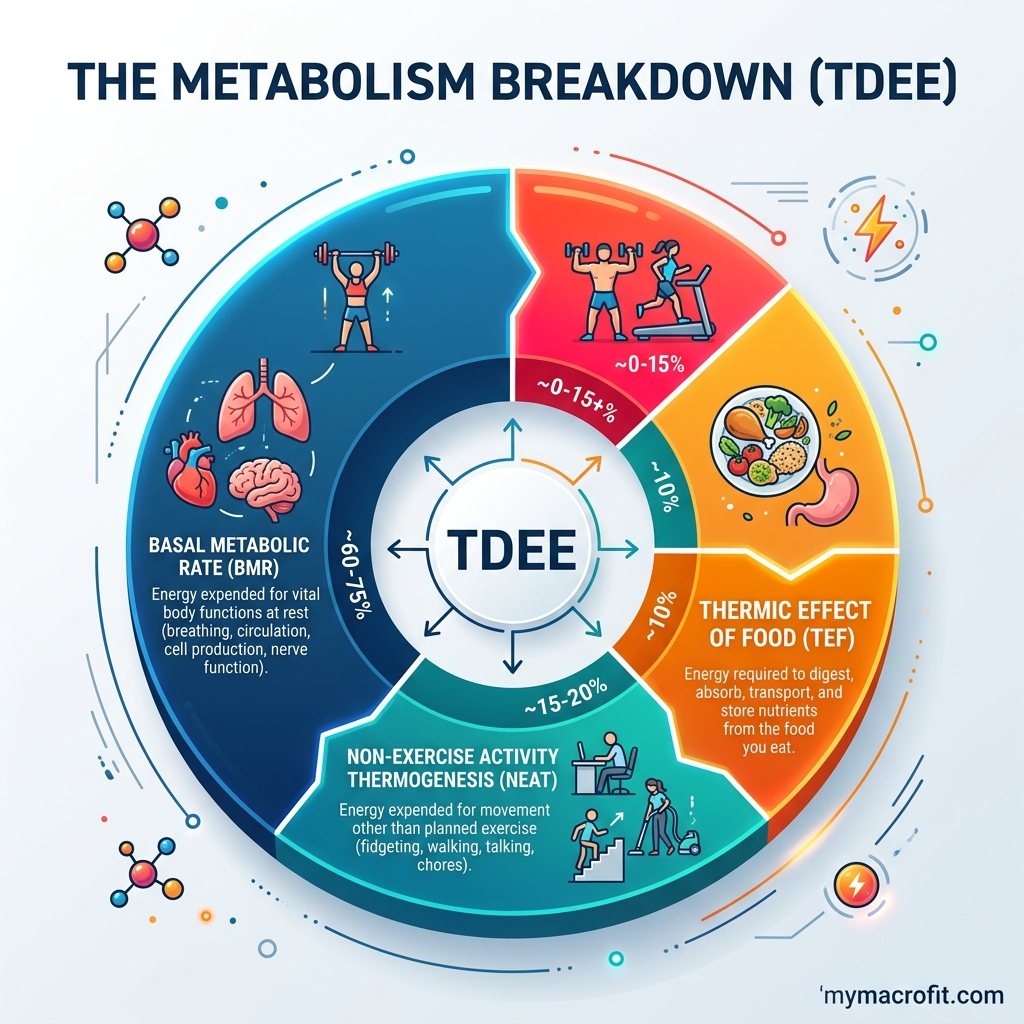
Your starting point is your TDEE, Total Daily Energy Expenditure. This is the number of calories your body burns each day across all activity.
The Mifflin-St Jeor equation:
- Men BMR: (10 × weight kg) + (6.25 × height cm) − (5 × age) + 5
- Women BMR: (10 × weight kg) + (6.25 × height cm) − (5 × age) − 161
Then multiply by your activity factor:
| Activity level | Multiplier | Example |
|---|---|---|
| Sedentary (desk job, little exercise) | × 1.2 | Office worker, no gym |
| Lightly active (1-3 workouts/week) | × 1.375 | Walking + occasional gym |
| Moderately active (3-5 workouts/week) | × 1.55 | Gym 4× per week |
| Very active (hard exercise 6-7 days) | × 1.725 | Daily training |
| Extremely active (physical job + gym) | × 1.9 | Manual labour + gym |
Set your deficit:
- Moderate (recommended): TDEE − 300 to 500 kcal → 0.3-0.5kg fat loss per week
- Aggressive: TDEE − 500 to 750 kcal → 0.5-0.75kg fat loss per week
- Maximum sustainable: TDEE − 1,000 kcal → ≤1kg fat loss per week
Do not exceed a 1,000 kcal daily deficit. Beyond this, lean mass loss accelerates significantly and hunger becomes unmanageable.
→ Use the TDEE Calculator to get your number in 60 seconds.
→ Read more: BMR vs TDEE Explained | Calorie Deficit Without Hunger
Step 2: Set Your Protein
Protein is the single most important macro for fat loss. High protein:
- Preserves muscle during a calorie deficit (prevents the metabolism from slowing)
- Is the most satiating macronutrient, reduces hunger after meals
- Has a high thermic effect (25-30% of protein calories are burned in digestion)
- Prevents the "skinny fat" outcome where weight is lost but body composition doesn't improve
Target for fat loss: 1.8-2.4g protein per kg bodyweight.
For a 70kg person, this is 126-168g protein per day. Most people eat 60-80g without intentional tracking, less than half what's needed. This is why most people on calorie-restricted diets lose muscle alongside fat.
→ Read more: 50 High Protein Foods Ranked | How Much Protein Do I Need?
→ Use the Protein Calculator for your personal target.
Step 3: Structure Your Meals
You don't need to eat six meals a day. You don't need to avoid carbs after 6pm. These are myths. What does matter:
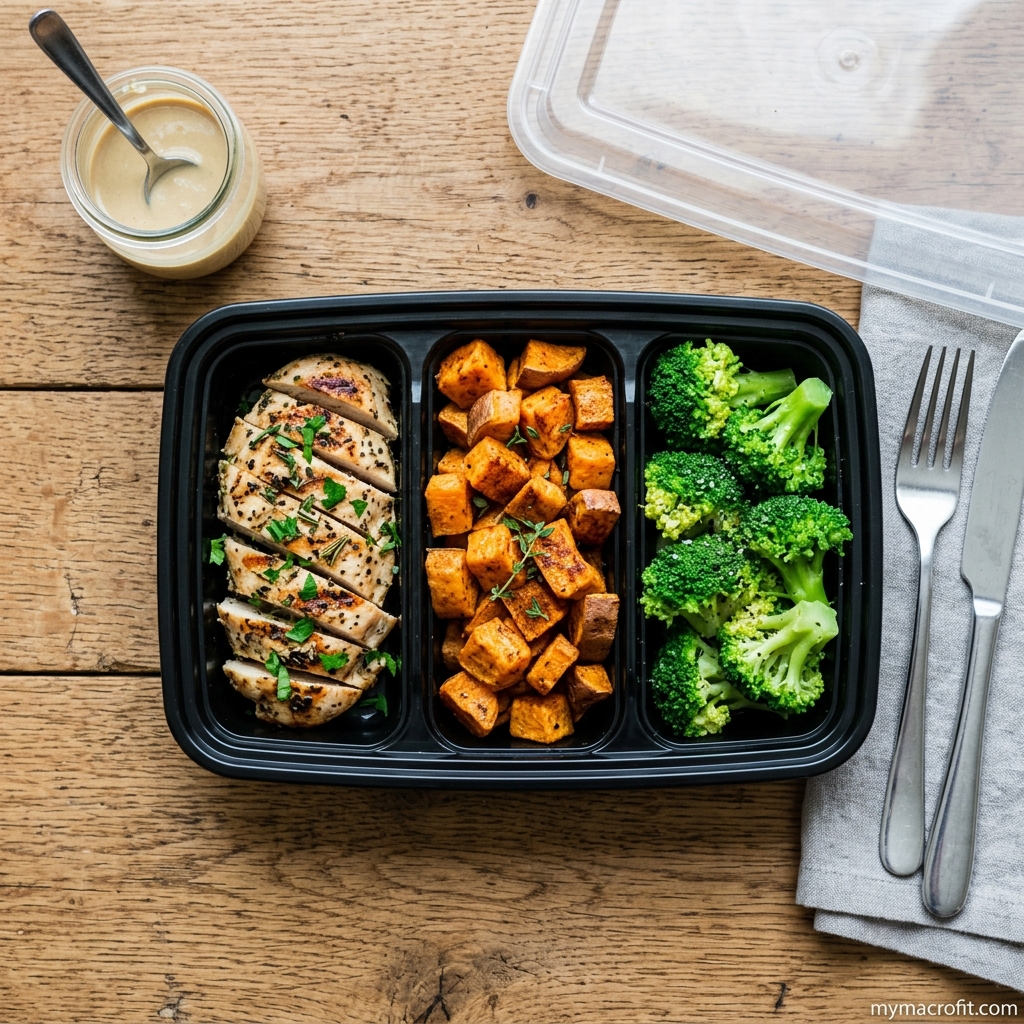
Anchor every meal to a protein source. Before deciding anything else, choose your protein (chicken, fish, eggs, Greek yogurt, legumes). Then build around it with vegetables and carbohydrates.
Aim for 30-50g protein per meal. At three to four meals per day, this hits your daily target without the need for protein shakes or supplements.
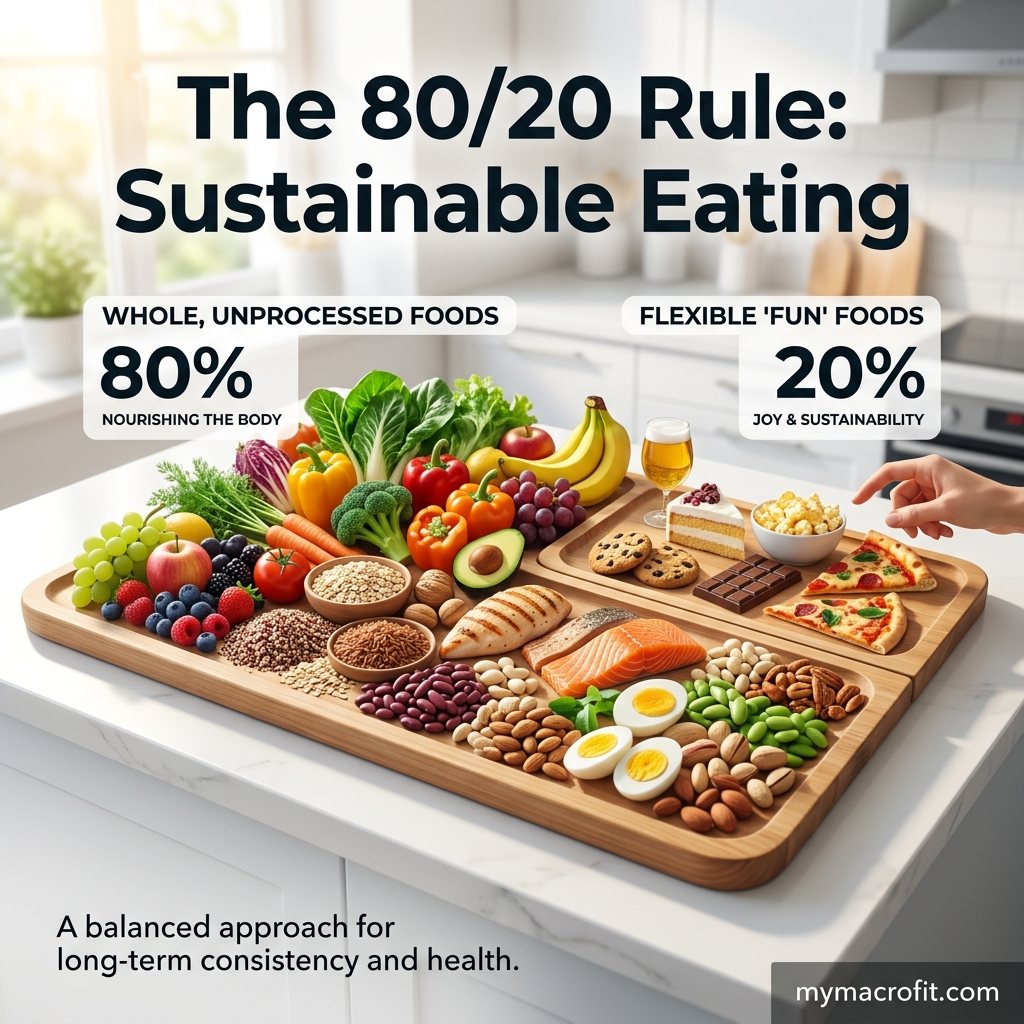
Eat mostly whole foods. Not because processed food is poison, but because whole foods are generally higher in fibre (which improves satiety and gut health), lower in calorie density (more volume per calorie), and more nutritious.
Don't ban entire food groups. Restriction creates cravings. Flexible dieting, where 80-90% of intake is nutritious whole food and 10-20% allows for preferences, has better long-term adherence than strict elimination diets.
→ Read more: What to Eat on 1,500 Calories
Step 4: Choose Your Training Approach
Exercise is not the primary driver of fat loss, that's the diet. But training significantly affects what kind of weight you lose and your long-term metabolic health.
Strength Training (Priority #1)
Resistance training builds and preserves muscle mass. More muscle = higher resting metabolism = more calories burned at rest, 24 hours a day. A person who gains 5kg of muscle over a year burns an additional ~65 kcal/day without doing anything differently.
Three sessions of strength training per week produces better long-term fat loss outcomes than five sessions of cardio, because cardio burns calories during the session, while strength training raises your baseline calorie burn permanently.
→ Read more: Strength Training for Weight Loss
Cardio (Supplement, Not Foundation)
Cardio is useful for:
- Increasing daily calorie expenditure
- Cardiovascular health
- Stress management and mood
- Active recovery on rest days
The most effective and sustainable cardio is walking. It's low-impact, can be done anywhere, doesn't impair recovery from strength training, and adds up significantly: 8,000-10,000 steps per day burns 300-500 extra kcal above baseline for most people.
→ Read more: Running for Weight Loss
The Most Common Fat Loss Mistakes
1. Eating back all exercise calories
Fitness trackers and cardio machines vastly overestimate calorie burn. If you eat back 500 "burned" calories that were actually 200, you've eliminated your deficit. Use TDEE (which already includes exercise) rather than adding exercise calories on top.
2. Weekends erasing weekday deficits
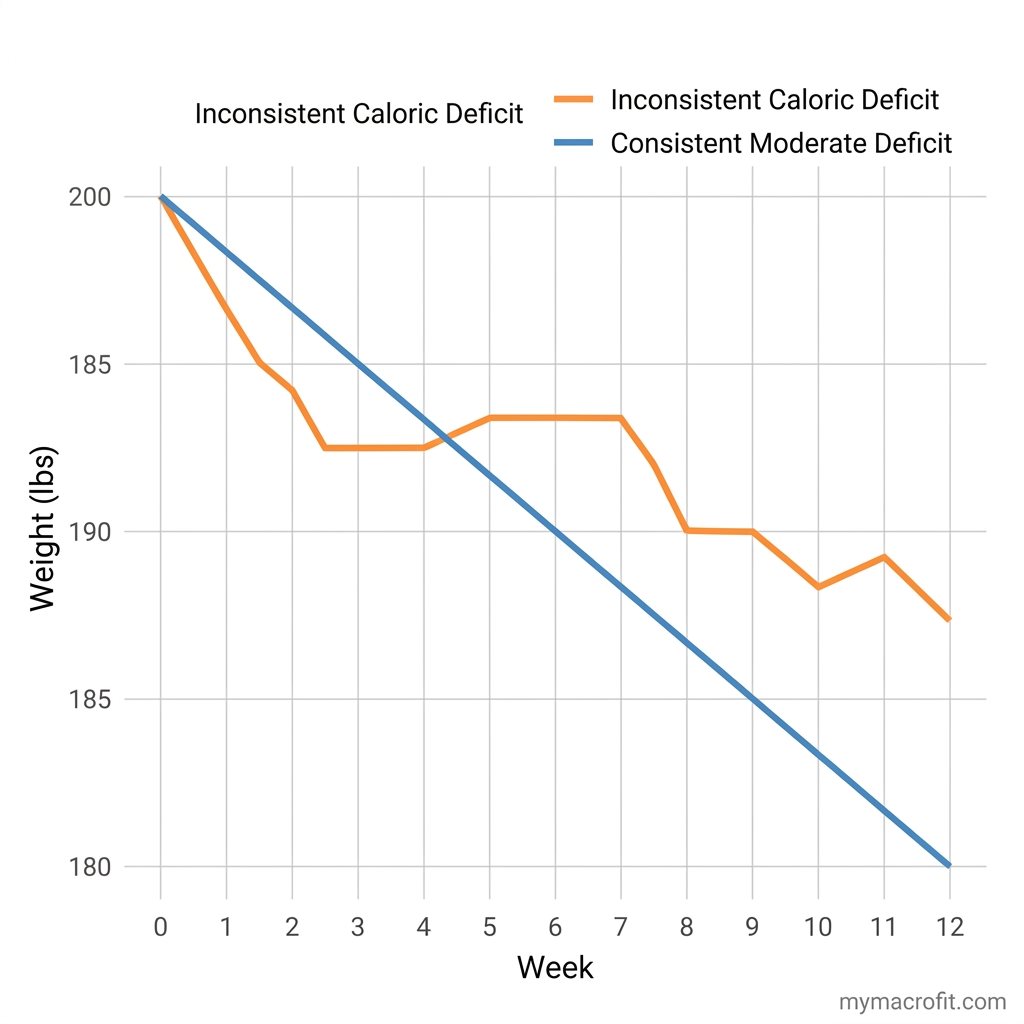
Monday-Friday at a 500 kcal deficit = 2,500 kcal deficit. Saturday-Sunday at +1,000 kcal above maintenance = 2,000 kcal surplus. Net result: 500 kcal weekly deficit = 0.07kg/week fat loss instead of 0.5kg. Consistency over the full week matters.
3. Not weighing food
A tablespoon of peanut butter can be 80 kcal or 150 kcal depending on how generously it's measured. For the first 4-6 weeks of tracking, use a digital food scale. The majority of people who "track and don't lose weight" are underestimating intake by 20-30%.
4. Losing weight too fast
Losing more than 0.5-0.75% of bodyweight per week reliably causes significant muscle loss. The goal is fat loss, not just weight loss. Slower is better.
5. Ignoring sleep
Sleep deprivation increases ghrelin (hunger hormone) by 15-20%, decreases leptin (satiety hormone), elevates cortisol, and impairs insulin sensitivity. People who sleep 5-6 hours lose significantly more muscle and less fat than those sleeping 7-9 hours on identical diets.
→ Read more: Sleep and Weight Loss: The Science
Plateaus: Why They Happen and How to Break Them
Fat loss plateaus are universal. They are not failures, they are the predictable result of adaptation.
Why they happen:
- Adaptive thermogenesis, your body reduces non-exercise activity (fidgeting, posture, spontaneous movement) to conserve energy as intake drops. TDEE can fall by 100-300 kcal.
- Lower bodyweight burns fewer calories, a 70kg person burns fewer calories than an 80kg person at the same activity level. As you lose weight, your TDEE decreases.
- Tracking drift, portion creep over weeks means you're eating more than you think.
How to break a plateau:
- Audit your tracking, weigh food for 1 week. Most plateaus resolve here.
- Reduce by 100-150 kcal, a small, targeted reduction is more sustainable than a large drop.
- Diet break, 1-2 weeks at maintenance partially restores leptin and reverses adaptive thermogenesis. Counterintuitively, this often accelerates subsequent fat loss.
- Increase activity, add 2,000 extra steps per day rather than reducing food further.
Special Populations
Women Over 40
Declining oestrogen during perimenopause shifts fat storage to the abdominal region and reduces muscle mass. The approach is the same (deficit + high protein + strength training) but resistance training becomes even more important, and stress management (cortisol management) is more impactful.
→ Read more: How to Lose Belly Fat for Women Over 40
Postpartum Weight Loss
The postpartum body operates under different rules. Breastfeeding, hormonal fluctuation, and sleep deprivation all affect fat loss. Aggressive restriction is inappropriate in the first 6-12 months. A patient, nutrient-dense approach wins.
→ Read more: Postpartum Weight Loss: A Realistic Timeline
PCOS
Insulin resistance (present in 70-80% of women with PCOS) makes fat loss harder and requires a modified approach: lower-GI carbohydrates, higher protein, and often targeted supplementation.
→ Read more: PCOS Diet and Macros
Realistic Fat Loss Timelines
| Weekly deficit | Weekly fat loss | Monthly fat loss | 10kg fat loss |
|---|---|---|---|
| 2,500 kcal (−357/day) | ~0.3kg | ~1.3kg | ~7-8 months |
| 3,500 kcal (−500/day) | ~0.45kg | ~2kg | ~5 months |
| 5,000 kcal (−714/day) | ~0.65kg | ~2.8kg | ~3.5 months |
| 7,000 kcal (−1,000/day) | ~0.9kg | ~4kg | ~2.5 months |
The 10-month timeline for 10kg of fat loss at a moderate deficit is sustainable and preserves muscle. The 2.5-month aggressive timeline will include significant muscle loss.
→ Read more: How to Lose 10kg: A Step-by-Step Plan
Your Action Plan
- Calculate your TDEE → TDEE Calculator
- Set a 300-500 kcal deficit → Calorie Deficit Calculator
- Calculate your macros → Macro Calculator
- Set your protein target → Protein Calculator
- Start tracking with a food scale for the first 4 weeks
- Add 3× strength training per week
- Walk 8,000+ steps per day
- Protect 7-9 hours of sleep
- Weigh yourself weekly, same conditions, track the trend (not daily fluctuations)
- Revisit and adjust every 4 weeks based on results
All Articles in This Guide
Save & share on Pinterest
Click any card to pin it — or share with someone who needs it.
The Complete Weight Loss Guide: Evidence-Based Fat Loss from Start to Finish
A comprehensive guide to sustainable fat loss, covering the calorie deficit, macros, training, sleep…
A comprehensive guide to sustainable fat loss, covering the calorie deficit, mac…
Read the full guide: The Complete Weight Loss Guide: Evidence-Based Fat Loss from Start to Finish
Free fitness tools
The Complete Weight Loss Guide: Evidence-Based Fat Loss from Start to Finish — use our free calculat…
Pinterest opens in a new tab. You can edit the description before saving.
Frequently Asked Questions
What is the most effective way to lose weight?+
How quickly can you safely lose weight?+
Why do most diets fail?+
Do you need to exercise to lose weight?+
About the Author
I'm the founder of MyMacroFit. I'm not a coach or a dietitian. I'm someone who wanted to lose weight, worked it out the hard way, and built the tools I wish I'd had.
View full profile →